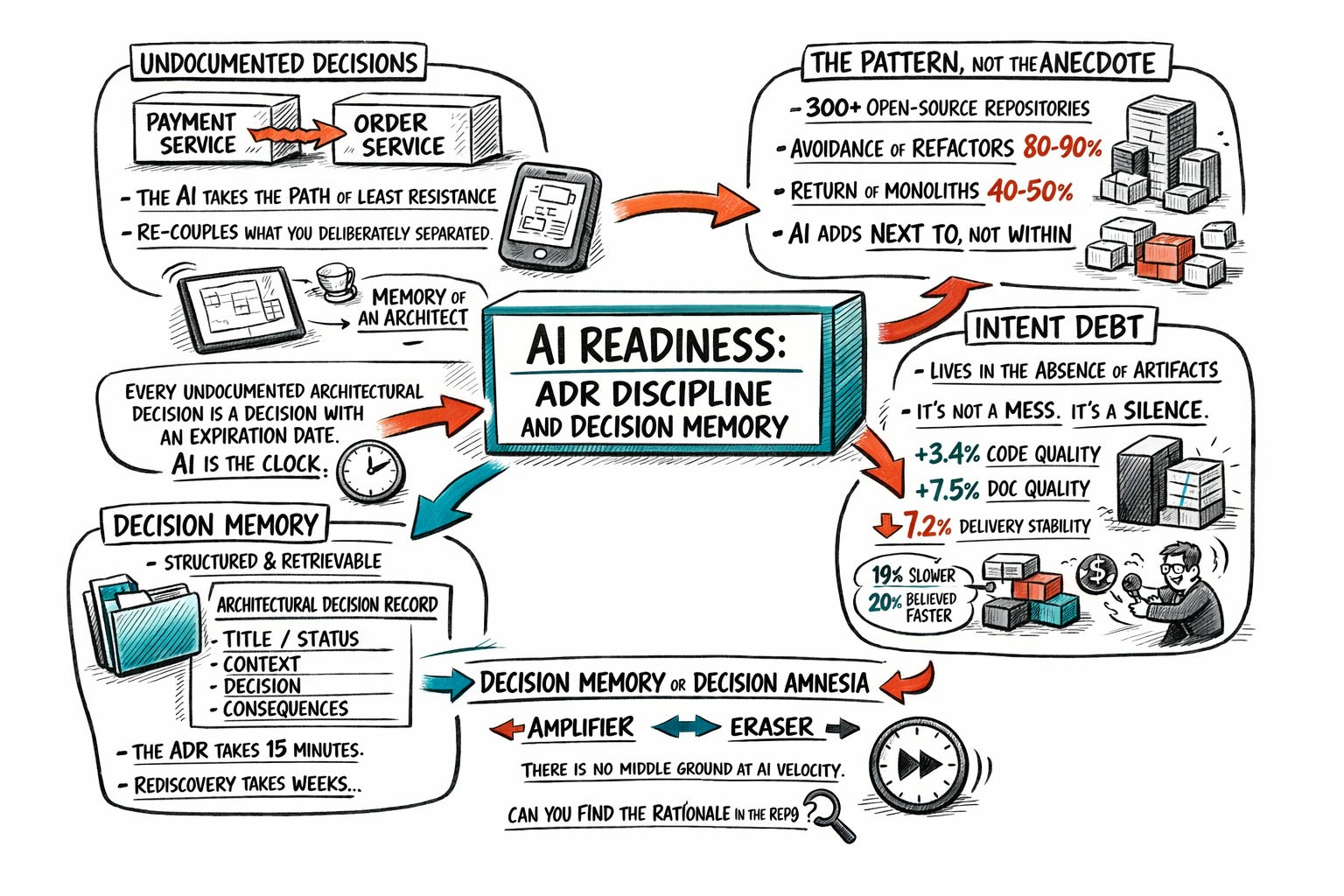

Your team spent four months decomposing the payment service from the order service. It was painful. There were arguments about where to draw the boundary. Someone made a compelling case for keeping them coupled. Someone else pulled up the incident from eighteen months prior, when a compliance change to payment processing froze deployments for three days because the order service was entangled. The team chose decomposition. They accepted higher network latency as the cost. They documented the decision on a whiteboard, took a photo, and moved on.
Eighteen months later, a developer uses an AI assistant to add a feature that touches both services. The AI takes the path of least resistance. It pulls shared logic into a common module. It adds direct database queries across service boundaries. It re-couples what your team deliberately separated.
The code compiles. The tests pass. The feature works.
The architect who led the decomposition would catch this in review. But she moved to the platform team six months ago. The reviewer sees code that follows existing patterns: “the old patterns, the ones that were supposed to be retired”, and approves. Why wouldn’t he? The code looks like what’s already there.
Nobody did anything wrong. The AI followed a pattern. The reviewer evaluated against patterns he could see. The decision that made those patterns obsolete existed in a whiteboard photo on someone’s phone and the memory of an architect who no longer reviews this code.
The decomposition is gone. Not in a dramatic incident. Not in a deliberate reversal. In a Tuesday afternoon pull request that nobody had a reason to question.
The Pattern, Not the Anecdote
This isn’t a one-off scenario. Ox Security’s 2025 analysis of 300+ open-source repositories identified ten recurring anti-patterns in AI-generated code. Two of them are directly about architectural reversal.
“Avoidance of Refactors” appeared in 80-90% of AI-generated code. AI doesn’t restructure existing code into better patterns. It adds new code alongside whatever already exists. It creates next to, not within.
“Return of Monoliths” appeared in 40-50%. AI defaults to tightly-coupled architectures, undoing decomposition decisions that teams made deliberately.
These aren’t bugs in the model. They’re the predictable behavior of a tool that optimizes for the immediate task without access to the reasoning behind the existing structure. AI was asked to add a feature. It added the feature. It didn’t ask whether the shortest path went through a boundary someone spent four months building.
Every undocumented architectural decision is a decision with an expiration date. AI is the clock.
Refactoring Used to Save You. It Doesn’t Anymore.
There’s a reason undocumented decisions survived as long as they did: refactoring.
When a senior developer saw new code that violated a service boundary, she moved it. When a tech lead noticed duplicated logic during a cleanup sprint, he consolidated it into the right module. Refactoring was the informal enforcement mechanism for architectural intent. Nobody wrote the rule down, but the team kept applying it, commit by commit, review by review.
That mechanism is collapsing.
GitClear’s 2025 analysis of 211 million changed lines of code tells the story in two numbers. Refactored (”moved”) code dropped from 24.1% of all changes in 2020 to 9.5% in 2024. Copy-pasted code rose from 8.3% to 12.3%. For the first time in their dataset, duplication exceeded refactoring.
Read that again. Developers are now copying code more often than they are restructuring it. The 8x increase in duplicated code blocks confirms the pattern: AI adds alongside. It doesn’t integrate.
This matters for architectural decisions because refactoring was never just about code cleanliness. It was the primary mechanism through which architectural intent propagated. Every time a senior developer moved a function into the correct service boundary, she was enforcing a decision nobody had written down. Every refactoring act was an implicit architectural decision record being applied.
Now that refactoring has collapsed, those implicit records stop propagating. New code accumulates outside the intended architecture, and nobody restructures it back. The architecture erodes from the edges inward, one AI-generated addition at a time.
And the people who used to do the restructuring? They’re still there. But they’re busy reviewing the 3-4x increase in AI-assisted commits, which means they have less time per review to catch the subtle violations. The informal mechanism is being squeezed from both sides: less refactoring, less review attention per change.
It’s the organizational equivalent of firing the only person who knew the building codes, then tripling the construction speed.
Intent Debt: The Debt You’re Not Measuring
An ealier article in this series explored how technical debt compounds under AI acceleration. This article introduces a different category: intent debt.
The distinction matters, and it’s not just taxonomic hairsplitting.
Technical debt lives in the code. You can measure it. You can see it in static analysis reports, in complexity scores, in the growing list of TODO comments that everyone has learned to ignore. It’s the mess you know about.
Intent debt lives in the absence of artifacts. It accumulates when nobody records why the code is structured the way it is. You can’t measure it because there’s nothing there to measure. It’s not a mess. It’s a silence.
Storey (2026) formalized this in a Triple Debt Model: technical debt in code, cognitive debt in people, intent debt in artifacts. Her definition of intent debt is precise: “the absence of externalized rationale that both developers and AI agents need to work safely with code.” It accumulates when “the goals and constraints that should guide the system are poorly captured or maintained.”
AI may actually reduce technical debt. Syntax errors drop. Logic bugs decrease. Code formatting improves. The linter is happy. The static analysis dashboard is trending green.
Meanwhile, intent debt grows. Because AI produces code without understanding why the existing code was structured the way it was. Every AI-generated change is a local optimization. Locally correct. Globally unaware.
DORA’s 2024 report captured this paradox in a finding that surprised even the researchers. For every 25% increase in AI adoption, code quality improved by 3.4% and documentation quality improved by 7.5%. But delivery stability dropped by 7.2%.
The code gets better. The system gets less stable.
That gap is intent debt materializing. Individual changes are locally correct. The system drifts from its intended architecture because nobody externalized what “intended” meant. Each change passes its own tests. The system as a whole moves further from the architecture that was designed to keep it coherent.
The METR study (2025) offers another lens on the same problem. Experienced developers working in mature, complex codebases were 19% slower with AI tools. They believed they were 20% faster.
Think about that for a moment. In mature codebases (the ones with the most accumulated architectural decisions, the richest history of deliberate trade-offs) AI doesn’t accelerate. It creates friction. It generates suggestions that violate undocumented intent, and experienced developers spend their time evaluating, correcting, and rejecting.
The less decision memory your codebase has, the more time your best people waste fighting their tools.
Decision Memory: The Capability You’re Not Building
Intent debt names the problem. Decision memory names what you build to stop it.
Decision memory is the organizational capability to recall why the system is structured the way it is. Not just that it uses microservices. Not just that the payment and order services are separate. But why they were separated. What was the alternative. What constraint drove the choice. What the team accepted as a trade-off.
Most teams have decision artifacts scattered across Confluence pages nobody visits, Slack threads that vanished into the scroll, meeting notes that were never written, and the heads of people who may or may not still work on the project. That’s not decision memory. That’s decision archaeology. It requires an excavation to find anything, and half of what you dig up is fossilized beyond usefulness.
Decision memory is structured, retrievable, and co-located with the code it governs.
The most proven artifact for building it is the Architectural Decision Record. Michael Nygard coined the term in 2011 and proposed a deliberately lightweight format: Title, Status, Context, Decision, Consequences. Five fields. Plain text. Version-controlled alongside the code.
His original observation: “one of the hardest things to track during the life of a project is the motivation behind certain decisions.”
That was true in 2011, when every line of code was written by a human who could, in theory, walk down the hall and ask about the motivation. It’s urgent now, when 20% or more of new code at companies like Google and Microsoft is written by a tool that has never walked down any hall.
Here’s what belongs in an ADR: the trade-off. Not “we use separate services for payment and order.” That’s a fact anyone can see in the repo. “We decomposed the payment service from the order service because coupling them caused a 3-day deployment freeze when payment compliance changed. We accepted higher network latency as the cost. We considered a shared library approach and rejected it because it re-introduced deployment coupling.” That’s decision memory. That’s the thing an AI can’t silently reverse if a reviewer can point to it during a pull request.
ADRs are not design documents. They’re not architecture diagrams. They’re not exhaustive specifications. They’re the why behind the decisions that shape the system’s structure. If you’re spending more than 15 minutes writing one, you’re over-engineering the solution to under-engineering.
Decision memory operates at three levels:
At the pattern level, clean up competing implementations. If your codebase teaches three different ways to structure a service boundary, AI will pick one. It won’t pick the right one. It’ll pick the most common one, which is often the oldest one, which is often the one you were trying to migrate away from. Make the right pattern dominant. Remove the alternatives.
At the decision level, record the rationale. ADRs. In the repo, next to the code, where they travel with the codebase. Not in a wiki three clicks away that the team forgot existed and the AI definitely doesn’t read.
At the constraint level, make critical decisions machine-enforceable. Later articles in this series will address CI enforcement and guardrails. This article’s point is simpler: you can’t enforce what you haven’t articulated. You can’t write a CI rule that blocks coupling violations if you haven’t first agreed on where the boundaries are and why.
“We don’t have time to write ADRs” is the most common objection. It’s also the most self-defeating. You don’t have time to re-discover why your services were decomposed when an AI-assisted refactor re-couples them. You don’t have time to debug the subtle data consistency issue that appears because someone, or something, added cross-boundary database calls to a service that was deliberately isolated. The ADR takes 15 minutes. The re-discovery takes weeks. The production incident takes longer.
Decision memory is cheap to build. Decision amnesia is expensive to live with.
Decision Memory or Decision Amnesia
Every undocumented architectural decision is a decision with an expiration date. It survives as long as the people who made it are present and paying attention. AI removed both requirements. The people don’t need to write the code anymore. And nobody is reviewing at the pace AI produces.
The mechanism that used to compensate (senior developers refactoring new code into the right structure) is collapsing. Refactoring rates have more than halved in four years. The informal enforcement of architectural intent is disappearing at the same moment that AI is producing code faster than anyone can review it.
Organizations under AI acceleration face a choice: decision memory or decision amnesia. There is no middle ground at AI velocity. Implicit decisions that survived for years through human refactoring and review are now being reversed in weeks.
AI doesn’t undo your architecture out of spite. It undoes it because it was asked to add a feature, and the shortest path went through a boundary that existed only in someone’s memory. A memory that was never written down, attached to a person who moved to another team, in a codebase that now changes faster than any one person can track.
When decisions are documented, AI becomes an architecture amplifier. It follows the boundaries because the boundaries are visible. It generates code that respects the structure because the structure is the loudest signal in the codebase.
When decisions are undocumented, AI becomes an architecture eraser. Locally correct. Globally destructive. One helpful commit at a time.
Pick any architectural decision your team has made in the last two years. Can you find the rationale in the repo? If not, that decision is already on borrowed time. And AI just set the clock to fast-forward.