
Two organizations adopt the same AI coding tools. Same models. Same IDE integrations. Same developer enthusiasm. Same budget.
One sees defect rates drop and delivery stabilize. The other watches incidents per pull request climb 23.5% and change failure rates spike by roughly 30%.
Same technology. Opposite outcomes.
The difference isn’t the AI. It’s what sits underneath. Whether the CI pipeline can reliably tell the difference between code that works and code that doesn’t. DORA’s 2025 State of AI-assisted Software Development report puts it bluntly: AI “magnifies the strengths of high-performing organizations and the dysfunctions of struggling ones.” Elite performers who meet their reliability targets are 5.8x more likely to have continuous integration in place, according to DORA’s 2021 Accelerate State of DevOps research. Not 10% more likely. Not twice as likely. Nearly six times.
That’s not a correlation footnote. It’s the mechanism by which acceleration becomes safe or catastrophic.
Everyone’s debating which AI tools to adopt. Almost nobody is asking whether their pipeline can tell the truth about what those tools produce.
The Pipeline Is Lying
Most engineering leaders assume their CI works. They know it’s not perfect. Maybe it’s slow. Maybe there’s a flaky test or two. But the general assumption is that the signal is roughly right: red means broken, green means safe.
That assumption is wrong. And it’s wrong in both directions.
Red lies first.
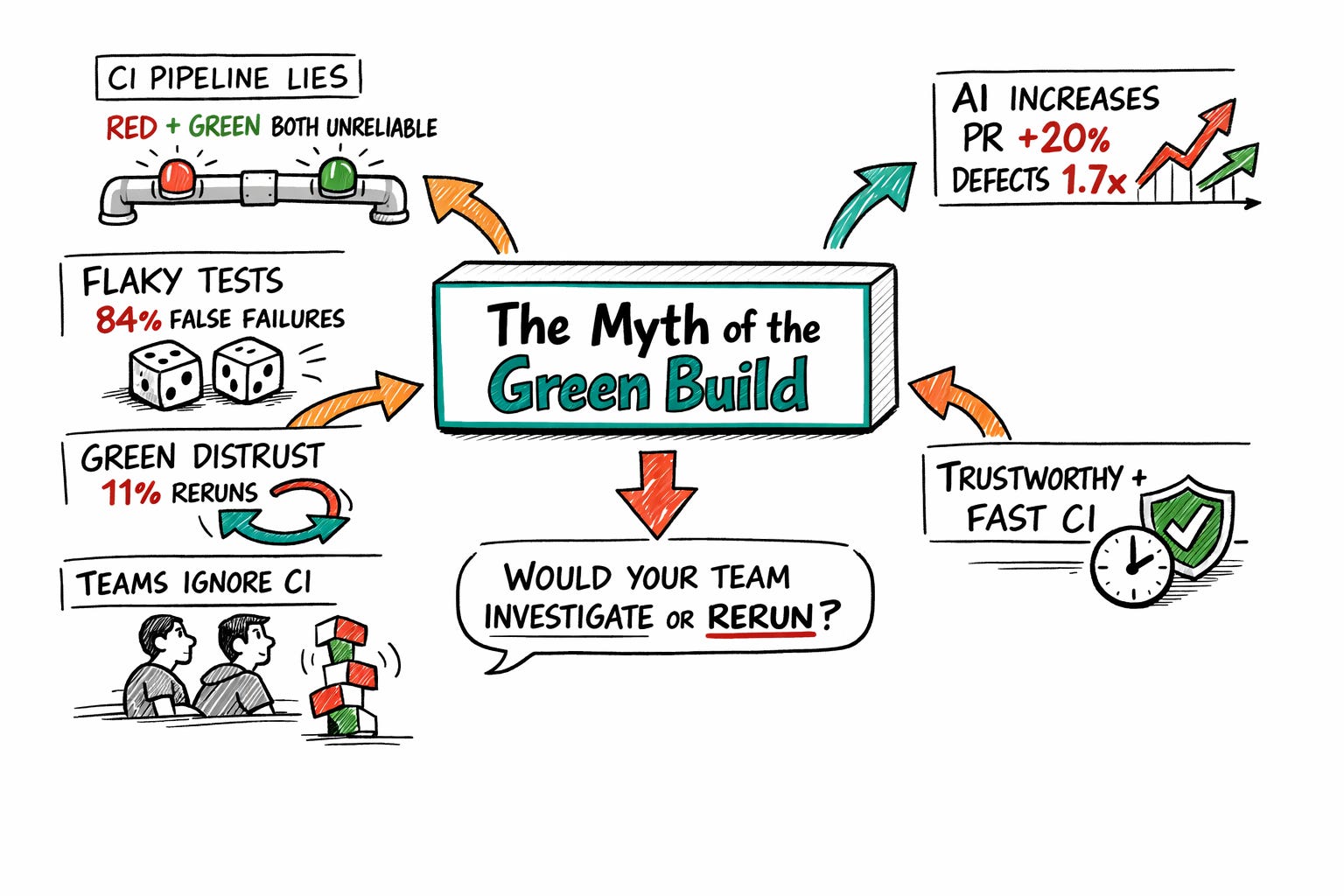
At Google, In 2016 John Micco reported that almost 16% of their tests have some level of flakiness. That sounds manageable until you see the consequence: 84% of all pass-to-fail transitions involve a flaky test. The vast majority of “failures” that CI reports are noise. The alarm fires and nothing is actually wrong.
This isn’t just a Google problem. The share of teams experiencing test flakiness grew from 10% in 2022 to 26% in 2025, a 160% increase in three years, based on analysis of over 10 million builds. At Atlassian, 15% of Jira backend tests are flaky. At Microsoft, 13%. At GitHub, 9% of tests produce flaky-caused red builds.
The math gets worse at scale. Take a test suite of 4,000 tests. Give each individual test a per-run flakiness rate of just 0.01%. That’s one in ten thousand. At that rate, 33% of your pipeline runs will fail on noise. Bump the per-test rate to 0.03% and 70% of your pipelines fail. Not because something is broken. Because the math of small probabilities compounds across thousands of tests.
The cost isn’t abstract. Microsoft spends $1.14 million per year on flaky tests. Atlassian developers waste over 150,000 hours annually. For a 50-developer team losing just 2% of coding time to flakiness, that’s $120,000 per year in developer salary alone.
But the real damage isn’t financial. It’s behavioral. When 79% of developers who encounter flaky tests rate them a moderate or serious problem, they don’t just complain. They adapt. They stop investigating failures. They type “rerun” instead of “investigate.” The alarm becomes background noise.
You know the Slack channel. Someone posts a red pipeline. Someone else replies, “just rerun it.” Nobody asks what failed. That’s not laziness. That’s a rational response to a system that lies 84% of the time.
Now the green lies.
This is the part most organizations miss entirely. Red is unreliable, fine, everyone suspects that. But green? Green means safe, right?
Not according to Aïdasso, Bordeleau, and Tizghadam, who studied 142,387 CI jobs across 81 industrial projects over six years. They found that 11% of successful builds get rerun. Developers don’t trust the green signal either.
Let that land. One in nine passing builds gets rerun because someone looked at the result and thought, “I don’t believe you.”
It gets stranger. Of all the reruns they observed, 51% started from a job that had already passed. More than half of the time developers spent rerunning builds, they were rerunning successes. Successful job reruns consumed 48% of all server time spent on reruns. In industrial settings, the rerun ratio was roughly 10x higher than in open-source projects.
The researchers identified 11 categories of silent failures hiding behind green status. Artifact operation errors (28%), caching bugs (23%), ignored exit codes (18%). These aren’t exotic edge cases. They’re infrastructure rot that makes green meaningless.
CircleCI’s analysis of 28 million workflows confirms the picture at scale. Main branch success rate has dropped to 70.8%, a five-year low. Nearly 3 out of every 10 merge attempts to production fail. The recommended benchmark is 90%. Most organizations aren’t close.
So here’s where you stand. Red doesn’t mean broken. Green doesn’t mean safe. The pipeline is unreliable in both directions, and your teams have quietly adapted by treating it as a suggestion rather than a signal. That adaptation was survivable when humans wrote all the code. What happens when you multiply the volume?
AI Multiplies Whatever Gets Through
Human code review hasn’t scaled with AI-generated volume. We’ll explore that dynamic in a later article in this series. What matters here is the consequence: CI is now the last mechanical gate between generated code and production.
And the load on that gate just increased sharply.
Cortex’s 2026 benchmark report found that pull requests per author are up 20% year-over-year. CircleCI reports daily workflow runs increased 59%. More code, moving faster, hitting the pipeline more often.
That would be fine if the code were getting is better. It isn’t.
CodeRabbit analyzed 470 GitHub pull requests, comparing 320 AI-co-authored PRs against 150 human-only PRs. AI-generated pull requests carried 1.7x more issues overall: 10.83 per PR versus 6.45 for human-written code. Logic and correctness errors were up 75%. Security vulnerabilities rose 1.5 to 2x.
Every one of those defects is something CI should catch. Logic errors need meaningful tests. Security issues need automated scans. If the pipeline is unreliable, these issues sail through to production.
Sun, Friberg, and Staron’s research on industrial CI/CD makes the stakes concrete. Pre-merge checks catch failures at a 5:3 ratio compared to post-merge. The pre-merge gate does disproportionate work. When that gate is unreliable, failures shift to post-merge. More expensive to diagnose, harder to attribute, and already affecting users.
Now connect the dots. Your pipeline already lies in both directions. Your teams already learned to ignore it. And the volume of code passing through that pipeline just increased by 20%, with each change carrying 1.7x more issues than before.
DORA’s 2024 Accelerate State of DevOps report, surveying over 39,000 professionals, measured exactly this dynamic. A 25% increase in AI adoption correlated with a 7.2% decrease in delivery stability. The 2025 report confirmed the pattern holds: AI adoption still increases delivery instability, even as individual effectiveness improves. The system got faster and less safe at the same time.
That’s not an AI technology failure. It’s a signal integrity failure. The pipeline can’t tell you the truth about what AI is producing. And if you can’t trust the signal, more volume doesn’t accelerate you. It buries you.
What “Reliable” Actually Means
Here’s the good news: you don’t need a perfect pipeline. You need a trustworthy one. The bar is lower than most people think, and the payoff is higher than most people expect.
Reliable CI means two things.
First: the signal is trusted. Developers investigate failures instead of rerunning. When red appears, the team’s first instinct is to look at the failure, not hit the retry button. That requires a signal that’s deterministic enough to mean something. Not zero flakiness. Deterministic enough that when the pipeline says “this is broken,” people believe it.
Second: the feedback is fast. Minutes, not hours. CircleCI reports that the median team currently takes 72 minutes to recover a green build, up 13% year-over-year. For mid-sized companies (21 to 50 employees), recovery takes roughly 3 hours, four times slower than the smallest and largest organizations. That’s too slow for human-paced development. For AI-paced development, where a developer might push three changes in the time it takes to get feedback on one, it’s unworkable.
Trusted and fast. That’s the bar.
Organizations that meet it get the amplifier working in their favor. More AI-generated changes, each mechanically verified. Defects caught before merge, where they’re cheapest. Feedback tight enough that a developer can correct course in the same working session, not the next sprint.
The data shows this gap clearly. CircleCI found that the top 5% of teams achieved a 97% throughput increase. The bottom quartile? No measurable increase at all. Same tools available to both. Different infrastructure underneath.
Whether the tests themselves protect the right behavior is a separate readiness question we’ll explore in a later article. This article is about the infrastructure that runs them. If that infrastructure lies, the most well-designed test suite in the world can’t save you.
The Multiplier Question
An important AI investment most organizations can make right now isn’t a better model. It isn’t a better IDE plugin. It isn’t a more sophisticated prompt library.
It’s fixing the pipeline that tells you whether the output is any good.
CI reliability isn’t DevOps hygiene. It’s the multiplier that determines whether every other AI investment pays off or quietly compounds into risk. As we explored in an earlier article, the differentiator between organizations that succeed with AI and those that don’t isn’t the technology. It’s the structural foundation underneath.
Two organizations. Same AI tools. Same models, same enthusiasm, same budget. One built a pipeline that tells the truth. The other built a dashboard that tells a story.
Same technology. Opposite outcomes.
If your pipeline went red right now, would your team investigate, or rerun?