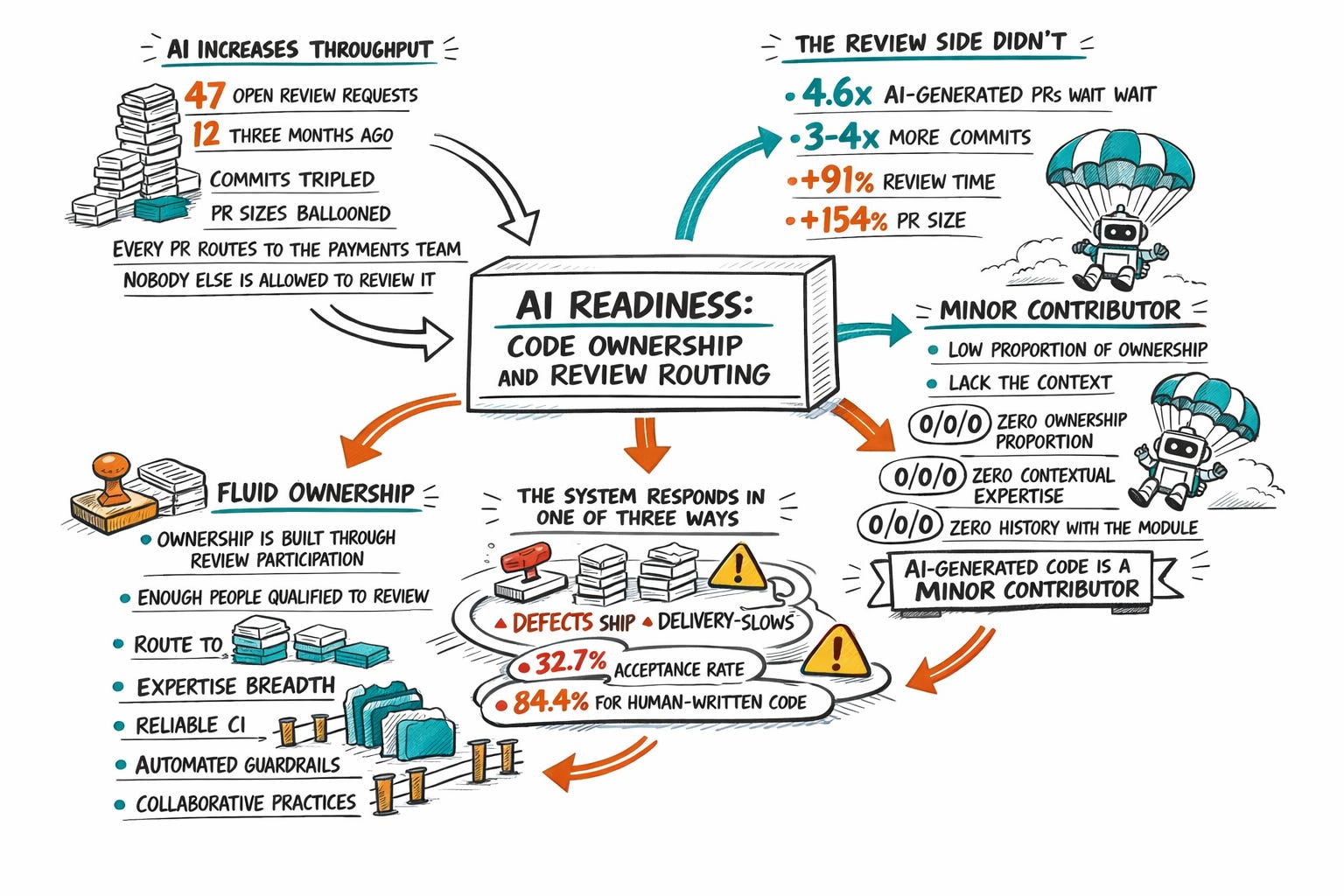

The payments team has 47 open review requests. Three months ago, it was 12.
Nothing about the product changed. Same services, same architecture, same number of teams. What changed is that every developer in every team started using AI coding tools. Commits tripled. Pull request sizes ballooned. And every PR that touches the payments service routes to the payments team because they own that code. Nobody else is allowed to review it. Nobody else has the context to.
The payments team isn’t slow. They’re the only team that can review this code. The organization was designed that way. One team per service. Each team owns its piece. Everyone else keeps out.
LinearB’s 2026 benchmarks report, analyzing 8.1 million pull requests across 4,800 engineering teams, found that AI-generated PRs wait 4.6x longer for review than human-written code. Not because reviewers are negligent. Because the review routing funnels everything through a single team, and that team was already at capacity before AI multiplied the volume.
Apiiro’s 2025 research quantified the supply side: AI-assisted developers produce 3–4x more commits than their non-AI peers. Faros AI, studying 10,000+ developers across 1,255 teams, found that PR review time increased 91% while average PR size grew 154%. The generation side scaled. The review side didn’t.
The AI didn’t create a review problem. It exposed that the organization had exactly one team qualified to review each part of the product. That’s not a review problem. That’s an ownership design problem.
The Most-Cited Ownership Study Says the Opposite of What People Think
When code ownership comes up, someone inevitably references the Microsoft Research study. Bird et al. (2011) studied Windows Vista and Windows 7 across 2,000+ developers and found that the number of “minor contributors” to a binary correlated with defects more strongly than any other metric Microsoft collects. Greiler et al. (2015) replicated it across four additional Microsoft products with 0.74 precision in classifying buggy files.
The conclusion everyone draws: fewer hands on the code means fewer bugs. Restrict access. Tighten ownership. Give each team its walled garden.
They’re misreading it.
Bird’s “minor contributors” aren’t people from other teams who happen to work across the product. They’re developers with a low proportion of ownership in the binary they touched. They parachute in, make a change to code they barely know, and leave. They lack the context to understand the consequences of what they changed.
That’s a very different claim than “only one team should touch this code.”
In an organization where developers regularly work across the product, review each other’s changes across team boundaries, and build shared understanding through collaborative practices, everyone has deep expertise. They’re not minor contributors in Bird’s sense. They’re co-owners with context.
The distinction matters enormously for AI readiness. AI-generated code IS a minor contributor in Bird’s framework. It has zero ownership proportion. Zero contextual expertise. Zero history with the module. Every AI-generated change arrives like a developer from a distant team who has never seen this service before. If the only team that can catch what’s wrong is the designated owning team, you’ve created a bottleneck for every cross-cutting change. If developers across multiple teams know this code, multiple people can catch what the AI missed.
Martin Fowler’s taxonomy frames the choice explicitly. Strong code ownership assigns each module to one team. Only that team changes it. Others submit requests and wait. Fowler opposes this directly: “there are just too many situations where something you need to do needs changes to other people’s code. Persuading them to make the change and waiting for the change often takes so long that it leads to delays and deeper problems.” That was written before AI tripled the queue.
Review Builds the Expertise That Ownership Requires
If narrow team ownership is the wrong model, what’s the right one? The answer isn’t “nobody owns anything.” It’s “ownership is built through review participation, and review participation must be broad enough to absorb the load.”
The research is clear on this. Thongtanunam et al. (ICSE 2016) studied six releases of Qt (a widely used cross-platform UI framework) and OpenStack (an open-source cloud infrastructure platform) and found that 67–86% of developers contributed to modules only through reviewing, not authoring code. They never wrote a line in those modules. But their reviews shaped the quality. When the researchers built ownership models that included review activity alongside authoring, the relationship with software quality was stronger. Developers with both low authoring and low review ownership were the strongest predictor of defect-prone modules.
Review isn’t a bureaucratic gate. It’s how ownership spreads.
Rigby & Bird (2013) quantified the mechanism. Across projects at Google, Microsoft, and several open-source communities, conducting peer review increases the number of distinct files a developer knows about by 66% to 150%. Every review builds a mental model. Every comment transfers context. Every approval distributes the knowledge that makes a developer capable of contributing to more parts of the product.
Narrow team ownership kills this mechanism. If only the owning team reviews changes to their service, only that team builds expertise in that service. Developers on other teams stay ignorant of how the pieces connect. The knowledge concentrates within team walls instead of distributing across the product. And when AI floods the system with volume, that concentration becomes a crisis.
How much of a crisis? McIntosh et al. (MSR 2014), in a Distinguished Paper studying three large open-source projects (Qt, VTK, and ITK), estimated that low code review participation produces up to five additional post-release defects per component. That’s not a marginal effect. That’s the difference between a stable release and a patch cycle.
Under AI acceleration, the feedback loop runs in the wrong direction. Narrow team ownership restricts review participation to the owning team. Restricted review participation restricts knowledge transfer across teams. Restricted knowledge transfer means only one team understands each part of the product. And that team’s review capacity stays flat while the volume flowing through their queue triples.
The Reviewer’s Math Doesn’t Close
SmartBear’s study at Cisco, one of the largest code review studies ever conducted (2,500 reviews, 3.2 million lines of code), established the human limits. Reviews should cover no more than 200–400 lines per session at a rate under 300 LOC per hour. After 60 minutes, effectiveness drops sharply. When reviewers exceed 450 LOC/hr, defect detection falls below average in 87% of cases.
These limits apply per reviewer. Having a team of four doesn’t help when each of them faces the same wall.
PR sizes grew 154% (Faros AI). As noted in an earlier article, each AI-generated PR carries 1.7x more issues than human-written code. The arrival rate is 3–4x higher (Apiiro). A team that could effectively review their service at human pace now faces pull requests that are 2.5x larger, arriving three to four times as often, each carrying more defects per line. A four-person team doesn’t have four times the capacity. They share the same context-switching costs, the same sprint commitments, the same meetings. The review queue grows faster than the team can absorb it.
Run those numbers through SmartBear’s limits. A 400-line PR at 300 LOC/hr takes about 80 minutes, already past the 60-minute effectiveness wall. A 1,000-line PR at the same rate takes over three hours. The reviewer’s attention degrades well before they finish. The second half of the review catches fewer defects than the first. Multiply by three to four times the volume, and the owning team’s week is consumed by reviews that are progressively less effective.
The system responds in one of three ways.
Rubber-stamp. Reviews get shorter, less thorough. The owning team approves changes they would have flagged a year ago because there are 46 more PRs behind this one. Defects ship. The Stack Overflow 2025 Developer Survey suggests this isn’t happening yet: 46% of developers actively distrust AI-generated code (up from 31% in 2024), and 66% cite “almost right, but not quite” as their biggest frustration. Reviewers are scrutinizing AI code more, not less.
Accept the queue. PRs wait. LinearB’s 4.6x wait time is the average across 8.1 million PRs. For teams with exclusive ownership, the number is likely worse. Delivery slows. The acceptance rate for AI-generated code sits at 32.7% versus 84.4% for human-written code (LinearB). Reviewers reject two-thirds of AI output. Every rejected PR is review effort that produced no merged code. The cost is real even when the output isn’t.
Distribute the load. Broaden expertise so that developers across multiple teams can review any part of the product. The queue shrinks because more people can absorb it. Defect detection stays high because each reviewer handles a manageable volume.
Most organizations are accidentally choosing the first two.
“But No Team Can Learn the Whole Product”
This is the objection that stops most conversations about broad ownership before they start. And it’s correct. No team needs to.
Sadowski et al. (ICSE 2018) studied Google’s code review practices across approximately 9 million reviewed changes. Over 80% of changes involved at most one review iteration. 70% were committed within 24 hours of being sent for review. Small changes received initial feedback in under an hour.
Google doesn’t ask every engineer to know every part of the product. They invest in readability requirements and shared ownership structures so that enough people are qualified to review any given change. The load distributes because any qualified reviewer can approve, regardless of which team they sit in. You don’t need every team to know everything. You need enough developers across the organization to know each area.
That’s the difference between narrow team ownership and fluid ownership. Narrow ownership draws a wall around each service and assigns one team. Only they can touch it, only they can review it. When that team is overloaded, the queue grows and there’s nothing anyone can do. Fluid ownership builds overlapping circles of expertise across team boundaries so the organization can absorb variable load. When the payment service gets a burst of AI-generated changes, developers from adjacent teams who’ve reviewed that code before can help absorb the reviews.
“But CODEOWNERS exists precisely because collective ownership didn’t work.” Also a fair point. Palanisamy et al. (2025), in the first large-scale empirical study of CODEOWNERS on GitHub (844,000+ pull requests, 10,287 code owners), found that CODEOWNERS adoption tends to reduce merge time and redistribute review workload. That’s real. CODEOWNERS files solve a routing problem.
The question is what they route to.
CODEOWNERS files that point to a single team create the bottleneck this article describes. CODEOWNERS files that include developers across teams distribute the load. The mechanism works. The configuration matters. Route to expertise breadth, not to organizational silos.
Distribute Expertise or Concentrate Risk
The instinct when review queues grow is to tighten control. More CODEOWNERS rules. Stricter team boundaries. Designated owning teams for every service, every path, every directory. It feels like quality protection. The evidence says it’s risk concentration.
In Navigating Complexity of Cognitive Load in Software Product Development, Viktor Grgić and I call the alternative fluid ownership: no fixed ownership over specific technical components, with teams empowered to address needs across the codebase. We contrast it with technical ownership and its documented consequences: silos, knowledge bottlenecks, and the coordination overhead that narrow boundaries create.
The common objection to shared ownership is the Tragedy of the Commons. If everybody is responsible, nobody is responsible. Elinor Ostrom won the Nobel Prize for debunking exactly that myth. Her research showed that with the right conditions, shared resources don’t degrade. They improve. Collective responsibility produces higher quality than private ownership when the community invests in the structures that make it work.
Those conditions aren’t optional. Reliable CI that catches mechanical defects before human review, as explored in an earlier article. Automated guardrails that enforce architectural rules, a topic for a later article. Collaborative practices that build shared context across the organization. These are the structural investments that make fluid ownership viable. Without them, broad ownership is just a wish. With them, it’s a capacity multiplier.
DORA’s 2025 research frames the pattern at the industry level: AI amplifies what’s already there. Broad expertise across teams is a structural strength. Single-team bottlenecks are a structural dysfunction. AI doesn’t change what you need. It reveals whether you have it.
The organizations absorbing AI-generated volume aren’t the ones with the tightest team boundaries. They’re the ones where enough developers across the organization have enough expertise that the review load distributes naturally. No single team bottleneck. No 4.6x queue. No rubber-stamping out of desperation.
If your payments team disappeared tomorrow, how many pull requests would have no one in the organization qualified to review them?