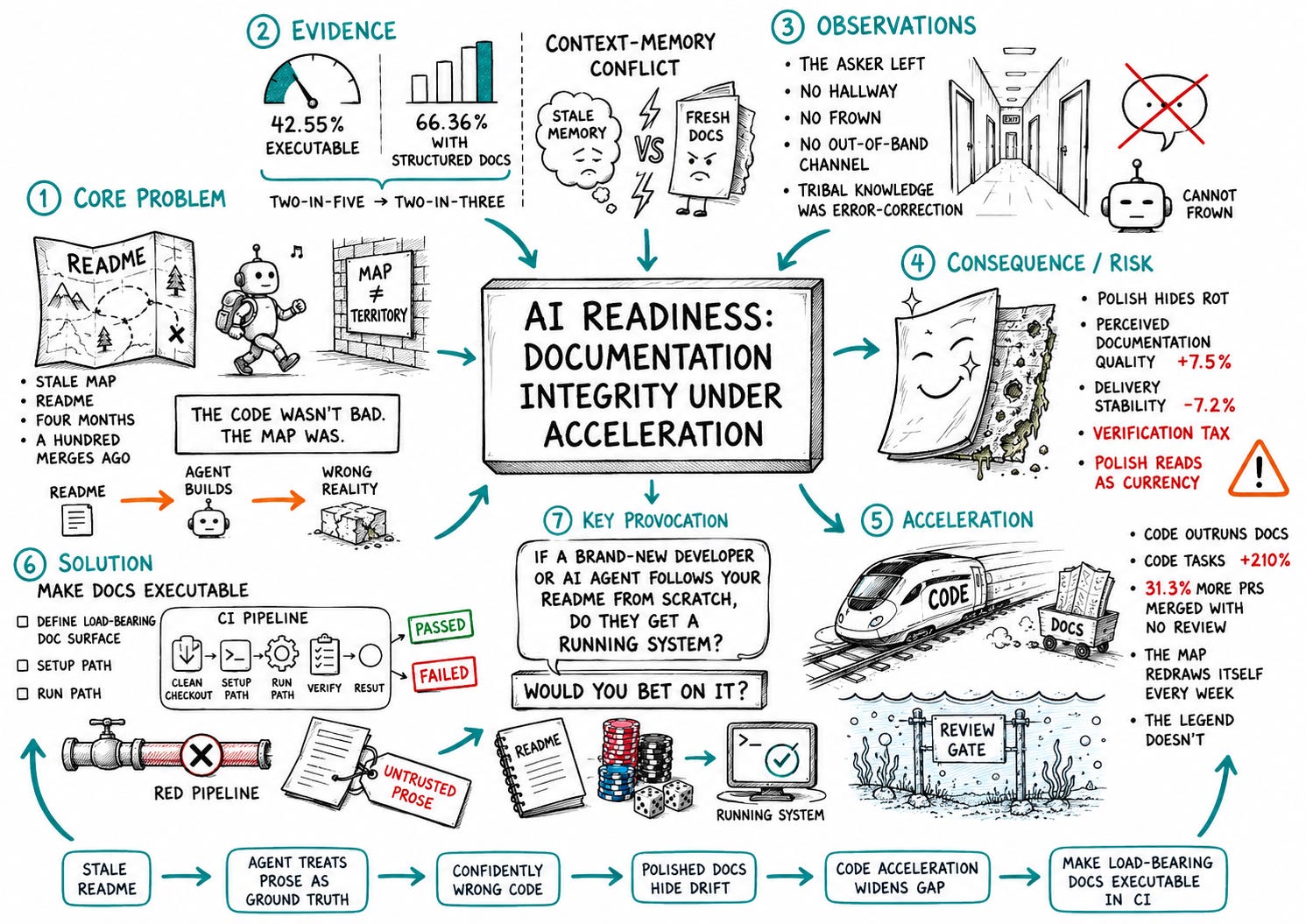

The agent picked up a small task and did it well.
It read the README to learn how the service starts. Followed the setup steps exactly, in order, no skipping. Pulled the documented config, wired against the documented endpoints, matched the patterns the docs described. Wrote clean code. Generated tests. Opened a tidy pull request, every check green, a commit message a human would be proud of.
It did everything right. There was exactly one thing it could not do.
It could not notice that the README describes a system that existed four months and a hundred merges ago. The setup section that mattered was last true in March. Since then the service moved to a different secrets backend, the local-run path changed, and the one command that used to bootstrap the database now silently does nothing. Nobody updated the prose. Nobody had to. Every human on the team already knew, and the new hire who didn’t just asked in the channel.
A person following those same steps from scratch would have hit the wall, frowned, and pinged someone. The frown is the whole mechanism. The agent can’t frown. It can’t ping. It can’t feel the small wrongness that tells a human the map and the territory have come apart. It built confidently on a stale map, and it could not have done otherwise.
The code wasn’t bad. The map was.
That gap, between what your documentation says and what your system does, used to be an annoyance a human routed around. It has quietly become a load-bearing machine input. And this is something you can verify, not just something you should fear.
The Reader Who Could Ask Left
For most of the history of software, your README, your runbooks, and your comments were a courtesy.
A courtesy with a built-in repair mechanism. The doc-reality gap always existed. Code changed faster than anyone updated the prose around it, and it never quite mattered, because the person reading the stale line had a fallback. They asked the colleague two desks over. They patched the gap out of band, silently, a hundred times a week, and most of them never even noticed they’d done it.
That fallback was not a nice-to-have. It was your error-correction layer. Tribal knowledge was the free, invisible org function that made it safe for prose to drift from the system it described. Your organization outsourced documentation integrity to hallway conversations, got it for free, and never put it on the books. You never priced it, so you never built a replacement, because you never had to.
Then the asker left.
The thing reading your docs today is increasingly an agent, and it has no hallway. It reads the README, the comments, the context files as ground truth, and it generates against whatever picture they paint. If the picture is stale, the code is confidently wrong against an environment that no longer matches. There is no out-of-band channel. There is no frown.
DORA’s 2026 report on the ROI of AI-assisted development states it almost word for word: “When an organization’s internal knowledge graph is fragmented or outdated, AI generates bloat, duplicated or irrelevant code that creates long-term technical debt”. The fix, they argue, is making sure agents have “the ground truth needed to make accurate decisions” inside your codebase. Read that phrase again. Ground truth. Your prose just got promoted from courtesy to the thing a machine treats as fact.
Which means the lever is no longer “write better docs.” The asker is gone, so the load-bearing docs have to become something you can verify. Hold that thought. The whole piece pays it off.
Even Good Docs Only Get You Two-Thirds
If you want to know how load-bearing the prose has become, somebody measured it.
Ashik and colleagues built a benchmark of 270 real-world API updates across eight Python libraries and ran eleven models against it. The setup is exactly the situation your team lives in: the system evolved after the model’s training cutoff, so the model’s internal picture is stale. The question is whether the generated code actually runs against the real environment.
Without good documentation, only 42.55% of the AI-generated code was executable. Not elegant. Not correct. Executable. Less than half of it would even run.
Feed the model structured documentation, and the executable rate climbs to 66.36%.
Sit with both halves of that number, because it carries the whole argument. The jump from roughly two-in-five to two-in-three is documentation doing real work: the quality of your prose now directly decides whether the generated code runs at all. Docs went from courtesy to the single variable that determines if the output executes.
And then the ceiling. Even with good documentation, a third of the output is still broken. Ashik’s team has a name for why: context-memory conflict. The model’s stale internal knowledge fights the fresh docs you hand it, and the stale memory often wins. Park that detail. It pays off later, when we get to what actually fixes this.
The Documentation Paradox
Here is the part that should make you uncomfortable, and it has nothing to do with a percentage yet.
Your dashboard says documentation quality is up. The team feels more documented than it has in years. There is more prose in the repo, it reads cleanly, and the wiki has never looked healthier. Meanwhile the runbook everyone trusts was last true in March, and nobody can tell, because the thing that made it look healthy is the same thing hiding that it’s stale.
The metric is rising because you have lost the ability to tell it’s wrong.
That is the paradox, and the numbers confirm it rather than reveal it. DORA’s 2024 report found that per 25% increase in AI adoption, perceived documentation quality rose 7.5%. Perceived: the survey captured how good the docs feel, not whether they’re true, and that distinction is the whole point. It was the single largest downstream effect they measured, because people are using AI to generate documentation. Over the same adoption increase, delivery stability fell 7.2%. The feeling went up. Reliability went down. One driver pushing both directions at once.
One more honest caveat, because it’s the point and not the fine print: these are effects associated with AI adoption, not proven to be caused by it. But the divergence is the signal. The dashboard measures the feeling, and the feeling is being inflated by the same tool that’s letting the underlying prose rot.
It gets sharper. DORA defines documentation quality to include “updatedness” by name. So the metric literally claims to measure currency, while currency degrades underneath it. The number that’s supposed to tell you the docs are fresh is going up precisely as the docs go stale.
DORA’s own caveat is the payload. The bar for what counts as “good documentation” may simply be dropping, because AI is now powerful enough to paper over low-quality docs. You’re not getting better at documentation. You may just be getting better at not noticing it’s bad.
Code Outruns the Docs
Set quality aside entirely. Throughput alone widens the gap.
Faros AI’s 2026 telemetry, drawn from two years across 22,000 developers and 4,000 teams, found that tasks involving code rose 210%. That’s the velocity reality your prose now lives inside. The system changes more than three times as fast as it used to, while documentation is still written and reviewed at human pace. The map redraws itself every week. The legend doesn’t.
Faros measured code throughput and quality, not documentation drift directly, so take this strictly as the velocity story: code outruns docs by arithmetic, not negligence. Nobody is being lazy. The prose simply cannot keep up with a system moving that fast.
And the gate that might have caught the drift is itself underwater. The one human who might have frowned at the stale step now reviews five times slower, when they review at all. In the same telemetry, 31.3% more pull requests merged with no review whatsoever. So the picture the docs describe moves on, the docs lag, and the checkpoint that might have noticed is drowning in volume. The gap doesn’t widen because anyone failed. It widens because the math says it must.
The Verification Tax
This is where the most reasonable objection shows up, and it deserves a straight answer.
“We don’t have a documentation problem. AI writes our docs now. They’re better than ever.”
That is precisely the trap. DORA’s 2026 report names the mechanism: AI-generated output looks remarkably similar to correct output, which shifts the work from producing to auditing. They call it the verification tax. It was coined for code, and it applies to prose without changing a word.
AI-generated documentation reads fluent, plausible, authoritative. That fluency is the camouflage. A runbook that obviously rotted at least warns you; the formatting is broken, the screenshots are ancient, you know not to trust it. The doc that looks maintained gives you no such warning. It is more dangerous, not less, because polish reads as currency, and the agent cannot tell well-written from true.
Which is also why the org that invested most can feel safest and be most exposed. A technical-writing team and a beautifully governed wiki buy you findability and prose quality, the exact dimension AI also inflates, and nothing on the dimension that now matters: whether the prose still matches the running system. A four-month-stale runbook that’s gorgeously written is worse to an agent than an ugly one. Your investment optimized the variable the machine can see and left the one it can’t. You feel more documented. You are less verifiable.
Make the Docs Executable
So here is the lever, and it was never “write better docs.” It is three moves a leader can mandate.
1. Define the load-bearing doc surface and give it an owner. Not all docs. The prose an agent treats as fact to do real work: the setup path, the run path, the operate path. That surface is an org asset. Name it, scope it, and put a name next to it. Everything else is secondary by definition.
2. Make the runnable parts of that surface executable in CI, from a clean checkout. This is the move, and it’s stricter than “verified,” because “verified” is where credibility goes to die. The setup and run instructions must actually run, on every green build, from nothing. If the documented steps stop producing a working system, the build breaks. That’s the entire point: the doc-reality gap stops being invisible the moment it costs you a red pipeline. Be honest about the boundary, though. Setup and run paths can execute. A rollback runbook or an architecture diagram cannot, so those get verified by other means: a scheduled game-day, a synthetic run, a human who owns checking them on a cadence. Claim that every doc can execute and you’ve lost the room. Claim that the ones that bootstrap the system must, and you’re right.
3. Demote everything else to labeled, untrusted prose. This is the actual structural decision, and it’s a policy, not a chore. Everything outside the executable surface gets explicitly labeled as prose the agent must not treat as ground truth. You are not documenting more. You are deciding, on the record, what your org permits a machine to believe.
This is also where the two-thirds ceiling pays off. Remember that even good docs left a third of the output broken, because of context-memory conflict. That’s the proof the answer can’t be “feed the machine more docs.” Better input helps and does not save you, which is exactly the case for verification over volume. Tests don’t make your code correct by being read; they make it correct by running and failing. Do the same thing to the prose that runs.
The reader who could ask is gone. You replace it with a check that runs. Documentation integrity becomes something you verify, not something you hope for.
The Diagnostic: Two Tiers
You can run this today.
If you lead the org, you don’t need to read a file. You ask four questions and watch how long the room stays quiet.
If a brand-new developer cloned our main repo today and followed only the README, would they get a running system? And does anyone here actually know, or are we guessing?
When did we last verify our setup and run docs against a clean checkout? Or do we find out they’re stale when onboarding breaks?
Are our AI agents pointed at our internal docs as ground truth, and do we know which docs they’re reading?
And separately: is any of that ground truth tested? Yes or no.
That last question is the one that makes the room go quiet, and the silence is the finding. Every “I don’t know” and every “no” is exposed process debt with a price tag, and DORA 2026 puts outdated internal knowledge squarely in the long-term-technical-debt column. Debt is a leadership concern, not a tidiness gripe an IC fixes on a slow afternoon.
If you’re closer to the code, run the IC version. Take your top operational doc. Follow it literally from a clean environment, like an agent that can’t ask anyone anything. Count how many steps are wrong, missing, or silently assume something only a veteran knows. Then ask the question that actually matters: would anything in CI have caught a single one of those?
If the honest answer is no, you’ve found your readiness ceiling. Not the model. Not the IDE. The prose nobody verifies.
The Map Was Last True in March
Go back to the agent in the opening.
It read the README, followed every step, and built clean, confident code on a map that stopped matching the territory in March. It did everything you’d want from a careful engineer except the one thing it can’t do, which is doubt. The diligence was real. It was aimed at a description nobody had checked against reality in four months.
For decades that was survivable, because the reader who hit the stale line could ask, and the asking quietly held the whole thing together. That reader has been replaced by a consumer that takes your prose literally, generates against it at pipeline speed, and rides a review gate that’s already underwater. Nobody upgraded the docs to survive a consumer that can’t ask. The fix isn’t a better model. It’s a check that runs.
So ask it plainly, about the codebase shipping AI-generated changes this week. If a brand-new developer, or an AI agent, follows your README from scratch, do they get a running system?
And would you bet on it?