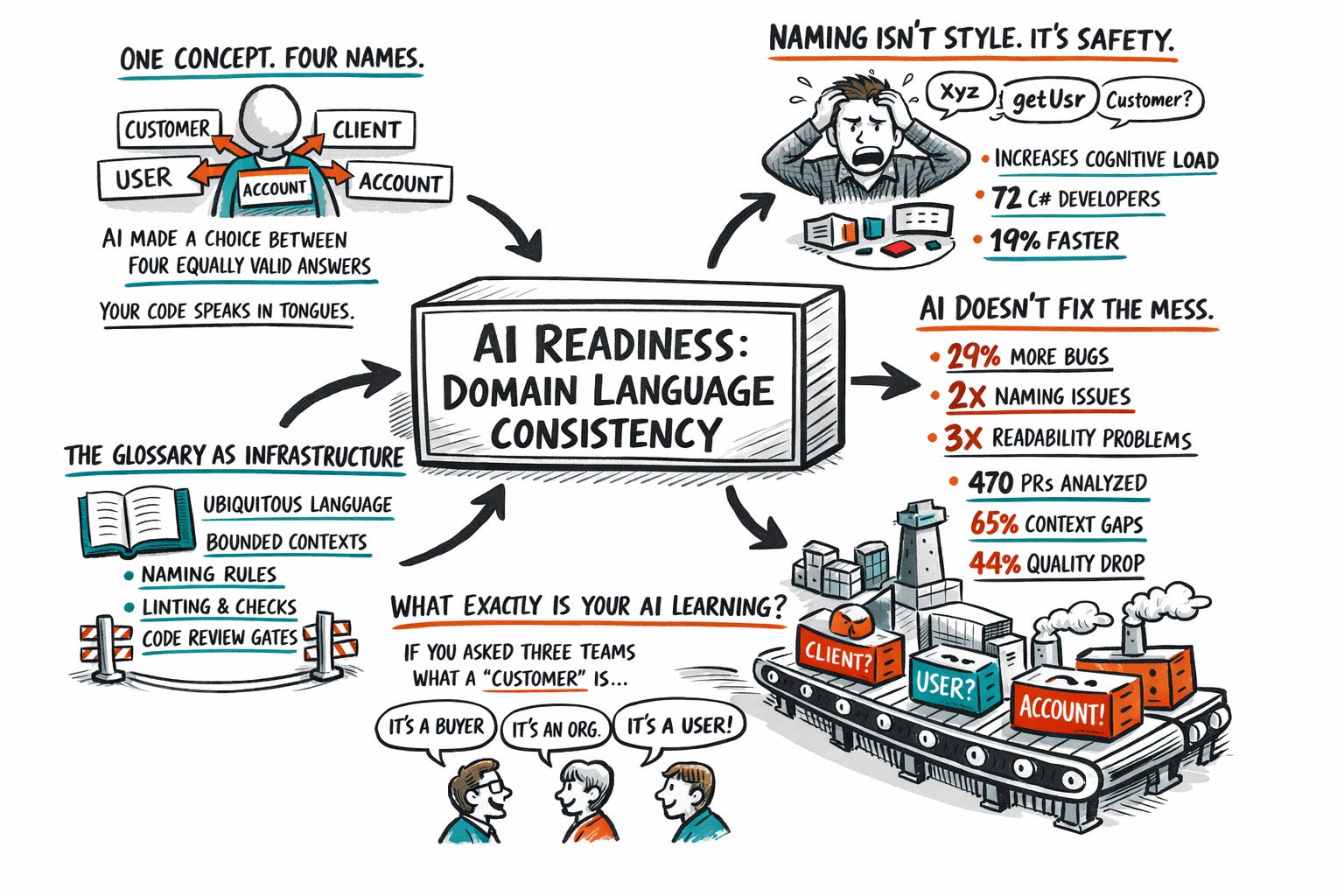

One concept. Four names.
In the order service, it’s a “customer.” In the billing service, it’s a “client.” The auth layer calls it a “user.” The CRM integration calls it an “account.” Nobody planned this. It accumulated over years, teams, and migrations. Different developers, different contexts, different preferences. All pointing at the same thing. All using different words.
Now an AI coding assistant gets asked to add a notification feature that touches all four services. It generates the code. It picks a name.
It picks “customer.”
The billing team rejects the PR. “We don’t use ‘customer’ here. It’s ‘client.’” The auth team raises a comment. “This should reference ‘user,’ not ‘customer.’” The CRM owner just sighs.
The AI didn’t make an error. It made a choice between four equally valid answers because the codebase taught it four contradictory truths. Three teams now spend review cycles correcting vocabulary instead of evaluating logic.
This is what happens when your domain language is inconsistent. Before AI, the problem was contained by human judgment. Developers who’d been around long enough knew which word to use where. They carried a mental glossary that no onboarding document captured. AI doesn’t have that institutional memory. It has your code. And your code speaks in tongues.
Eric Evans named this problem two decades ago. In Domain-Driven Design, he introduced Ubiquitous Language: a shared, rigorous vocabulary used consistently across all communication, documentation, and code. Class names, method names, variables, database tables, API routes. The same word means the same thing everywhere within a defined context boundary.
The insight wasn’t about aesthetics. It was about reducing ambiguity to the point where the names themselves carry meaning. What Evans couldn’t have predicted is that this principle now governs not just human comprehension but machine comprehension.
AI tools are the most literal readers your codebase will ever have. They don’t infer intent. They replicate patterns. If your codebase calls the same thing “customer,” “client,” “user,” and “account” depending on which team wrote the service, AI will faithfully reproduce that fragmentation in every suggestion it makes.
If your domain has no consistent language, what exactly is your AI learning?
Naming Isn’t Style. It’s Safety.
Most organizations treat naming as a code style issue. Something reasonable people can disagree about, enforce loosely through PR reviews, and quietly ignored when deadlines are close. Like tabs versus spaces or bracket placement.
The research says otherwise. And the evidence isn’t based on opinions or surveys. It’s physiological.
Fakhoury et al. performed a study that used functional near-infrared spectroscopy (fNIRS), a brain imaging technique, to measure what happens when developers read code containing linguistic antipatterns. These are inconsistencies between what a name promises and what the code actually does, or between naming conventions within the same codebase.
The result: naming inconsistencies significantly increase cognitive load. Not just on the inconsistent identifiers themselves, but throughout the entire code snippet. The confusion radiates outward. When a developer encounters a method called getCustomer that actually modifies state, the cognitive burden doesn’t stay localized. It contaminates how they read everything around it.
Their follow-up study, published in Empirical Software Engineering in 2019, confirmed the pattern. Both lexical and structural inconsistencies resulted in lower performance in time and success rate for bug localization. The developers weren’t just confused. They were measurably slower at finding bugs and less likely to find them at all.
Hofmeister et al. found in a study of 72 professional C# developers that code using full words instead of letters or abbreviations was comprehended 19% faster on average when participants searched for semantic defects. This was a result about comprehension speed, not just reading comfort.
But the finding that closes the loop comes from Aghajani et al., whose large-scale empirical study examined what happens when API names misrepresent their behavior. When there’s a mismatch between what a name promises and what the implementation does, projects consuming those APIs see a 29% increase in the likelihood of introducing bugs.
Twenty-nine percent. Because the names didn’t match the behavior. Not a marginal effect in an edge case. A significant increase in defect rates measured across real projects.
Here’s why this matters for AI readiness. That 29% was measured when human developers consumed APIs with misleading names. AI coding tools are downstream consumers of your codebase’s naming patterns at a scale no human team will ever match. They read every file, every method signature, every variable name. And they reproduce what they find.
Inconsistent naming doesn’t just confuse your AI tools. It turns them into a defect multiplier operating at industrial volume.
AI Doesn’t Fix the Mess. It Industrializes It.
If inconsistent naming increases bugs by 29% when humans write the code, what happens when AI generates code at 10x the volume, learning from that same inconsistent context?
CodeRabbit analyzed 470 GitHub pull requests in December 2025, comparing 320 AI-co-authored PRs against 150 human-only PRs. The naming results were the worst in the entire dataset.
AI-generated code introduced nearly 2x more naming inconsistencies than human-written code. Unclear naming, mismatched terminology, generic identifiers that could mean anything. Readability issues spiked more than 3x, the single largest gap across every quality dimension CodeRabbit measured.
AI doesn’t arrive with clean conventions and impose order on your codebase. It reads your existing patterns, averages across contradictory signals, and produces output that compiles but belongs to no team’s vocabulary. If four teams each use a different word for the same concept, AI generates a fifth.
Qodo’s 2025 State of AI Code Quality report shows what this looks like from the developer’s side. 65% of developers report context gaps when using AI for refactoring. Among those who blame degraded code quality on AI, 44% attribute it to missing context. Developers receiving inconsistent style suggestions are 1.5x more likely to flag “code not in line with team standards” as a major blocker.
The tool isn’t failing. The context is failing the tool.
This is where Evans’s concept of Bounded Contexts meets its modern stress test. Evans designed Bounded Contexts as deliberate boundaries where vocabulary stays consistent. Within a context, terms mean one thing. Between contexts, you translate deliberately. The boundary is where ambiguity gets eliminated.
AI tools don’t respect those boundaries. They operate across every file, every service, every team’s vocabulary simultaneously. The Ubiquitous Language that was supposed to stay local gets blended into a generic pidgin that belongs to no context. A method name that made perfect sense in the billing service gets cloned into the order service, where it’s misleading. And the AI has no way to know the difference because your codebase never made the boundaries explicit.
DORA’s 2025 research frames this structurally: AI “magnifies the strengths of high-performing organizations and the dysfunctions of struggling ones.” Domain language consistency is one of those structural strengths. Or dysfunctions. Consistent vocabulary makes AI output predictable, reviews faster, and onboarding cheaper. Inconsistent vocabulary turns every generated line into a review burden. The organizations getting the most from AI aren’t giving it better prompts. They’re giving it better input.
The Glossary as Infrastructure
Another high impact AI investment many organizations can make isn’t a better model. It isn’t better prompts. It isn’t a fancier IDE integration.
It’s a glossary.
Not a wiki page that nobody reads. Not a Confluence document last updated in 2022. A shared, enforced vocabulary for the domain concepts that matter most, expressed in the codebase itself through consistent naming conventions, module boundaries, and the code review standards that protect both.
When every service, every team, and every AI tool calls the same thing by the same name, the generated code fits instead of fragmenting. When domain boundaries are explicit, AI tools can generate code that respects those boundaries instead of blending them into noise.
Enforced is the critical word. As we’ll explore in a later articles, conventions that aren’t mechanically enforced don’t survive contact with velocity. A glossary that exists only in documentation is a wish. A glossary embedded in linting rules, naming checks, and code review gates is infrastructure.
As we explored in earlier articles, the structural foundation underneath your AI tools determines whether acceleration helps or hurts. Whether the question is your pipeline’s ability to tell the truth about code quality, your organization’s relationship to technical debt, or your codebase’s consistency of vocabulary, the pattern is the same. AI doesn’t fix broken foundations. It builds on them. At scale. At speed.
Domain language consistency isn’t about elegance. It’s about whether AI amplifies your architecture or dissolves it.
If you asked three teams what a “customer” is in your system, would you get the same answer?