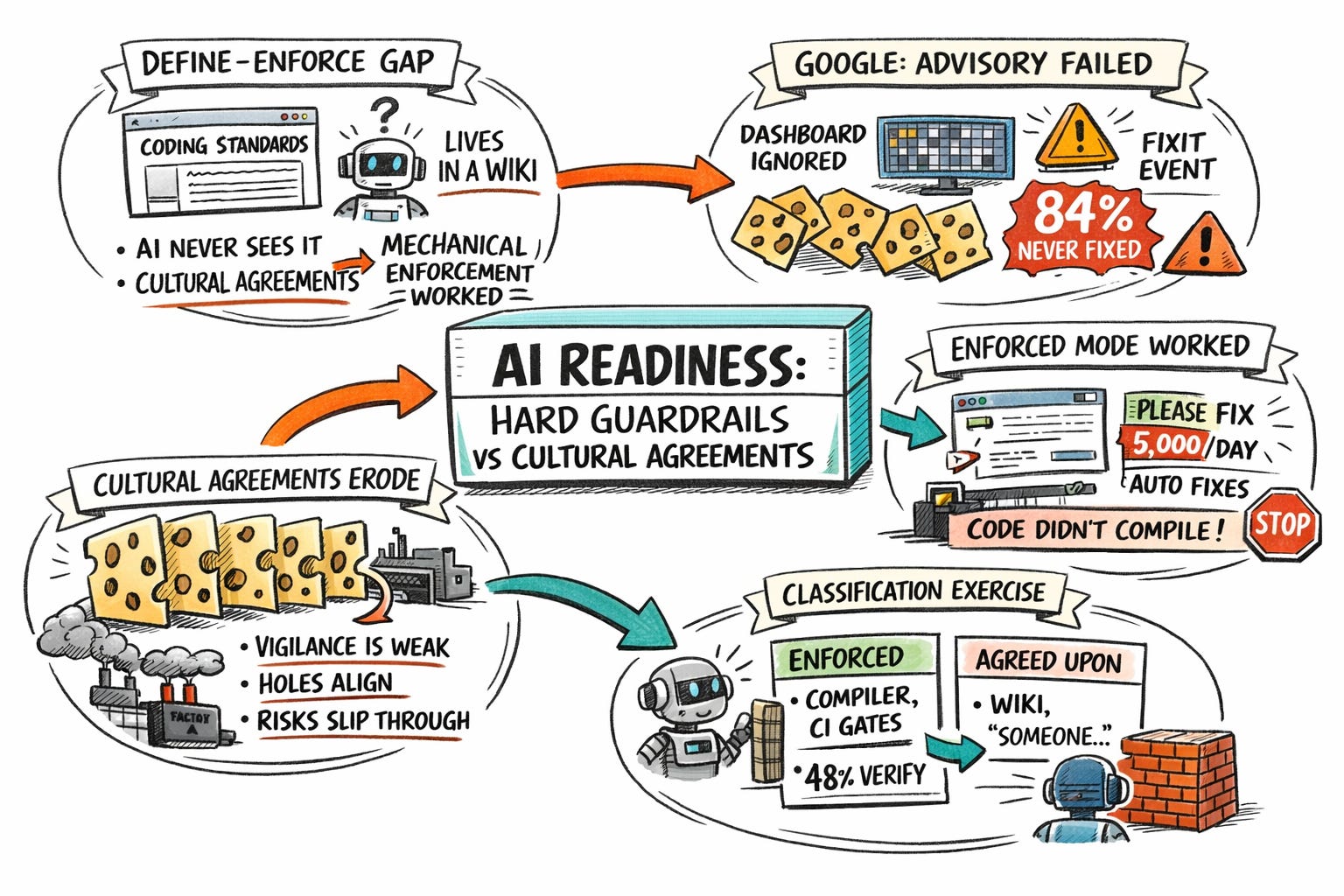

Your organization has a coding standards document. It was last updated sometime last year. It lives in a wiki page with a comfortable number of views, most of which were the author checking whether anyone read it. Every developer on the team would agree with its contents. If asked, they’d say the standards matter.
AI has never seen that page. It doesn’t know your team agreed to always paginate list endpoints. It doesn’t know you prefer constructor injection over field injection. It doesn’t know about the convention against raw SQL in service layers, the unwritten rule about error handling in public APIs, or the architectural boundary between modules that exists in everyone’s head but nowhere in the pipeline.
And it never will. Not because AI is incapable. Because those standards were never in a form that anything, human or machine, could reliably enforce.
This is the tenth article in the AI Readiness series. Nine articles examined specific domains: technical debt, CI reliability, domain language, code ownership, branching strategy, security assumptions, decision memory, pipeline capacity, and test meaningfulness. Each one circled the same hidden variable without naming it. The standards that held under AI acceleration were the ones backed by mechanical enforcement. The ones that collapsed were the ones that existed as cultural agreements. This article names the pattern.
The Define-Enforce Gap
Google tried three times to make static analysis work in advisory mode.
First, in 2006, they built a central dashboard for FindBugs results. Few engineers visited it. Then they ran a company-wide “fixit” event where hundreds of engineers reviewed thousands of warnings. The effort was temporary. Then they integrated findings into code review, but false positives and per-developer customization killed adoption.
In advisory mode, 84% of filed bugs were never fixed.
Same organization. Same engineers. Same codebase. Three attempts. One outcome: when the system advised, people ignored.
Then Google changed the mechanism. They built Tricorder, which embedded analysis directly into code review with mandatory visibility. No separate dashboard to visit. No optional workflow. Findings appeared in the review interface. Reviewers clicked “Please Fix” roughly 5,000 times per day. Automated fixes were applied 3,000 times per day. “Not useful” clicks: about 250 per day.
They also built Error Prone, which turned specific checks into compiler errors. Code that violated them didn’t compile. Full stop. The code that caused the 2012 Twitter outage on Election Night would not have compiled at Google, because an Error Prone check would have caught it before the code ever ran.
84% ignored in advisory mode. Thousands of fixes per day in enforced mode. The only variable was the enforcement mechanism.
This isn’t a Google-specific finding. Across 246 Java projects using SonarQube in advisory mode, only 8.76% of flagged issues were actually fixed. Median resolution time for the ones that did get fixed: 19 days. Team leaders called the warnings relevant. They still didn’t act on them.
And a survey of 56 developers found the gap distilled into two numbers: 66% of projects define how to use static analysis tools. Only 37% enforce their usage for new contributions. Two-thirds have the Confluence page. One-third makes the pipeline block on it.
The gap doesn’t stabilize over time. It widens. Analysis of 7,357 warning suppressions across 46 Python projects found that half of all suppressions were useless: they didn’t even affect an active warning. But they accumulated. Some unintentionally hid future warnings. Developers don’t just ignore advisory systems. They build infrastructure to make the warnings disappear.
There’s a version of this gap that doesn’t involve static analysis at all. Researchers monitored 2,443 software engineers over two and a half years via IDE instrumentation and found that half of all developers in the study didn’t test. Most programming sessions ended without a single test execution. When asked, developers estimated they spent about half their time testing. The measured figure was one quarter. “We agree to test” is a cultural agreement. Half the team doesn’t do it. The half that does overestimates their effort by a factor of two. Without CI gates that force test execution, the agreement is a pleasant fiction.
Why Cultural Agreements Erode
The instinct is to blame developers. They’re careless. They don’t follow process. They need more training, more reminders, more strongly worded wiki pages.
This is what James Reason, writing in the British Medical Journal, calls the person approach to error. Its countermeasures are “poster campaigns, writing procedures, disciplinary measures, naming, blaming, and shaming.” And it doesn’t work. Not in hospitals. Not in aviation. Not in software.
Reason’s alternative is the system approach. Errors aren’t moral failures. They’re consequences of upstream conditions. The countermeasures are defense layers, and not all defense layers are equal. Engineered safeguards (automatic shutdowns, physical barriers, alarms) have small, stable holes. Administrative controls (procedures, policies, documented standards) have larger holes that shift with fatigue, pressure, and time. Each layer is a slice of Swiss cheese. Accidents happen when the holes align.
“We cannot change the human condition,” Reason wrote, “but we can change the conditions under which humans work.”
Cultural agreements are administrative controls. They depend on every developer independently maintaining standards across every commit, every review, every merge. They depend on vigilance. Vigilance is the weakest defense layer in Reason’s model. Not because people are lazy. Because human attention is a finite, depletable resource operating in systems that weren’t designed to conserve it.
A controlled experiment made this concrete. Twenty-nine developers performed system extension tasks in codebases with either high or low technical debt. Developers exposed to high-debt codebases were significantly more likely to introduce additional code smells, choose non-descriptive names, and re-implement rather than reuse functionality. Quality degradation is self-perpetuating. The first violation that slips through an unenforced standard becomes the signal that the standard is optional. The broken window invites the next one.
Manufacturing solved this decades ago. Shigeo Shingo’s mistake-proofing hierarchy, established in 1986, distinguishes three types of inspection. Judgment inspection sorts good from bad after the fact. Informative inspection feeds back to correct the process. Source inspection checks conditions before work begins and prevents defects from occurring. A compiler error is source inspection. A code review comment hoping someone notices a violation is judgment inspection. The hierarchy was clear forty years ago: prevention is categorically stronger than detection, and both are stronger than hoping someone catches it.
Dan Luu catalogued what happens when software organizations rely on hope. The November 2014 Azure outage started when a developer force-pushed a bad configuration, skipping staging, testing, and canary rules that were documented but not enforced. New hires at dysfunctional organizations don’t rebel against broken processes. They absorb them. “People don’t automatically know what should be normal,” Luu observed, “and when new people are onboarded, they can just as easily learn deviant processes.” The @flaky test library, which re-runs failing tests and reports a pass if any run succeeds, was standard practice at some of the most prominent companies in the industry. Documented reliability standards. Actual uptime: two nines.
AI Widens the Gap
Everything above applies to human developers. AI makes it worse for a reason that’s structural, not incidental: AI doesn’t absorb implicit knowledge.
A human developer, over months, picks up unwritten rules. They learn from code review comments that the team doesn’t use mutable state in that module. They overhear in standup that the payment service has a quirky retry behavior that explains why the tests look the way they do. They develop a feel for what belongs and what doesn’t. The process is slow, imperfect, and unreliable. But it exists.
AI has none of it. Researchers at MIT explained why: every company’s codebase is “kind of different and unique,” and proprietary conventions are “fundamentally out of distribution” for models trained on public code. AI generates code that “looks plausible but doesn’t align with specific internal conventions, helper functions, or architectural patterns.” It calls functions that don’t exist in your codebase. It produces solutions that fail your CI pipeline for violating standards it never encountered. Not because it’s broken. Because the standards were never expressed in a form it could encounter.
The response from the industry has been to write rules files. .cursorrules. CLAUDE.md. .github/copilot-instructions.md. These are a step in the right direction. They’re also a form of advisory mode. The AI reads them. It follows them some of the time. A NeurIPS 2025 workshop paper tested the best case: GPT-4o explicitly prompted with governance rules achieved 73% enforcement accuracy. That means 27% of violations slipped through even when the policy was literally in the prompt. A CI gate that blocks on a violation has a miss rate of zero for the check it runs. Soft enforcement through context is better than nothing. It is not enforcement.
And the verification behavior is predictable. Sonar’s 2026 developer survey found that 96% of developers don’t fully trust AI-generated code, but only 48% actively verify it. 42% of all committed code is now AI-generated. The distrust is a belief. Verification is an action. Without enforcement gates, beliefs don’t translate to behavior. Developers know the code is risky. They commit it anyway. Not because they’re reckless. Because the system doesn’t stop them.
At the organizational level, the gap is even starker. 75% of organizations have established AI usage policies, but only 36% have adopted formal governance frameworks. Having a policy is a cultural agreement. Having a governance framework with enforcement mechanisms is a hard guardrail. The 39-point gap is where exposure accumulates. Deloitte’s 2026 enterprise survey found governance readiness trailing at 30% while technical infrastructure readiness sits at 43%. Organizations are scaling the technology without scaling the enforcement.
This explains a finding that’s puzzled industry observers since DORA’s 2024 report. For every 25% increase in AI adoption, individual metrics improved: code quality up 3.4%, review speed up 3.1%. But organizational delivery degraded: throughput down 1.5%, stability down 7.2%. The improvements happen where AI touches the code directly. The degradation happens where the system lacks enforcement to absorb what AI produces. DORA calls AI an amplifier. It magnifies strengths and dysfunctions. Enforcement is a strength. Cultural agreements are a dysfunction.
The Pattern Across This Series
Nine articles. One hidden variable.
An earlier article established that a reliable CI pipeline is a hard guardrail; a flaky one is a suggestion. Another showed that “we don’t commit secrets” is a cultural agreement while a pre-commit hook that blocks secrets is a guardrail. Decision records without CI enforcement are cultural artifacts that AI refactors will silently undo. Coverage thresholds are soft guardrails, satisfied trivially by AI-generated fake tests; mutation testing in CI is a hard guardrail. And the velocity simulation showed that each pipeline station’s capacity depends on whether its quality checks are enforced or optional.
Every domain. Same variable. The organizations that were ready for AI acceleration had invested in mechanical enforcement. The ones that struggled had invested in documentation.
The Classification Exercise
Here’s the readiness assessment for this article.
List every quality standard your organization relies on. Coding conventions. Testing requirements. Security policies. Architectural boundaries. Review expectations. Deployment checks. Documentation standards.
For each one, ask a single question: if this standard is violated, does something mechanical stop the violation from reaching production?
Write two columns.
Left column: enforced. Compiler errors. Linter rules that block the build. CI gates that reject the merge. Pre-commit hooks. Type system constraints. Automated security scans that fail the pipeline.
Right column: agreed upon. Wiki pages. Onboarding documents. Team agreements. “Someone would catch it in review.” Coding guidelines that exist as suggestions. Architectural boundaries that live in everyone’s head.
The right column is your exposure under AI acceleration. Those are the standards AI will bypass. Not maliciously. Not incompetently. Because AI encounters constraints during execution, or it encounters nothing. It doesn’t read your wiki. It doesn’t attend your standup. It doesn’t absorb your culture. It runs into walls, or it runs through open space.
The organizations best positioned for AI acceleration aren’t the ones with the most comprehensive documentation. They’re the ones with the shortest right column.
Reason was right. You cannot change the human condition. You also cannot change the AI condition. Both respond to the system they work in. Design a system that enforces, and both humans and AI produce better outcomes. Design a system that asks nicely, and watch what happens when the volume doubles.