

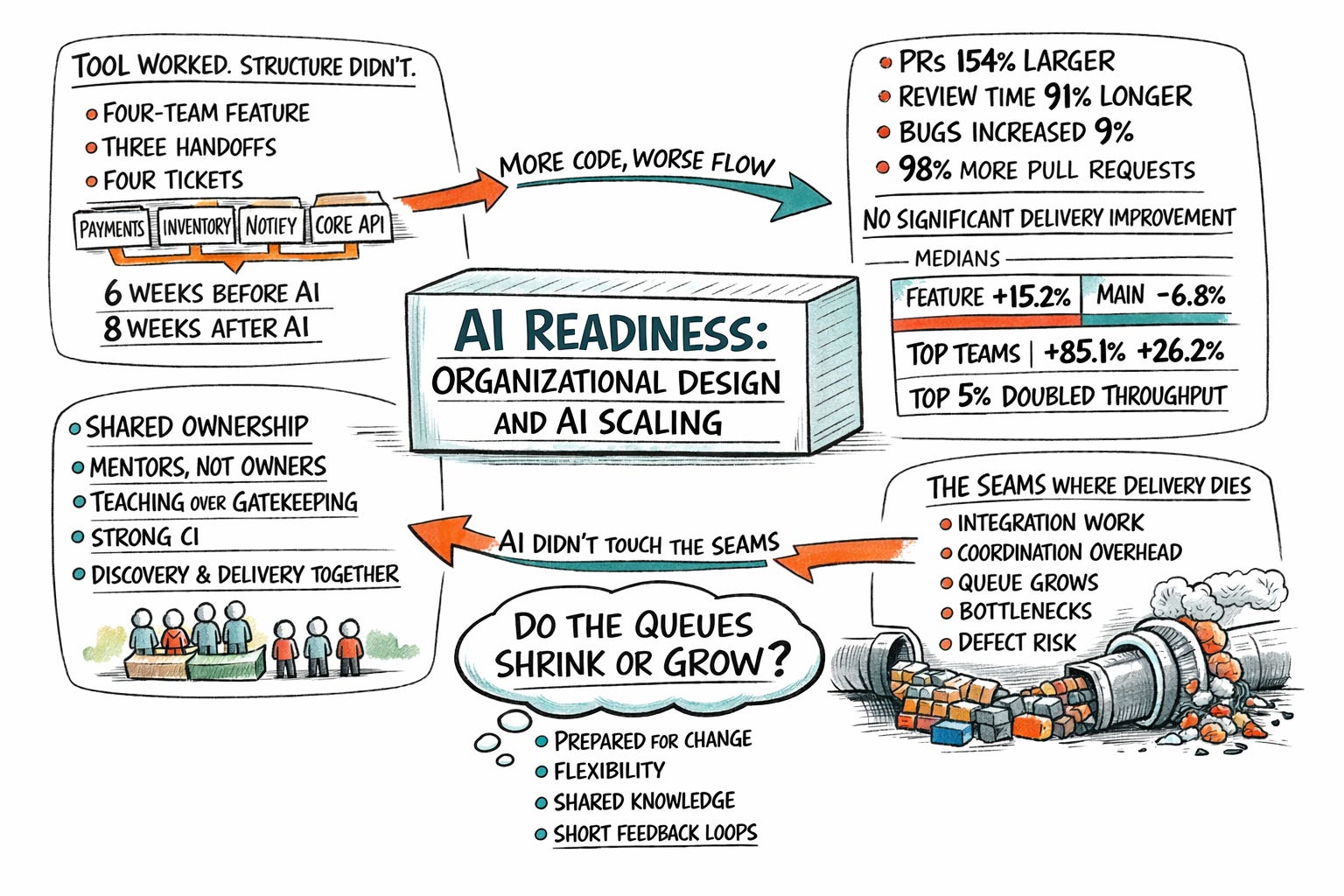
A product manager requests a customer-facing feature. It touches payments, inventory, notifications, and the core API. Under the component-team structure, four teams must coordinate. Three handoffs. The product manager files four tickets. One per team.
Before AI, this took six weeks. Two weeks of actual work. Four weeks of waiting, coordinating, and integrating across team boundaries. The organization considered this normal.
Then AI arrived. Each team’s developers generated code twice as fast. The product manager expected three weeks. It took eight. The handoff queues didn’t shrink. They grew. Each team produced more code, faster, which meant more integration work, faster, which meant more review across boundaries where nobody fully understood the other team’s domain. The PRs were 154% larger. The review time was 91% longer. The feature shipped two weeks later than before AI. With more bugs.
The tool worked. The structure didn’t.
In “AI Success Starts at the Bottom,” I put organizational design at the bottom of the iceberg: the layer that determines whether every layer above it functions, and the one most organizations refuse to touch. The previous article in this series examined the code level: can a module be understood in isolation? This one moves up to the organizational level: can a team absorb AI output within its own domain?
CircleCI’s 2026 State of Software Delivery report, analyzing 28+ million CI/CD workflows across 22,000 organizations, answered the question. Median teams increased throughput on feature branches by 15.2% but decreased throughput on main branch by 6.8%. Teams are generating more. Organizations are delivering less. The top 10%, however, increased both: 85.1% on feature branches and 26.2% on main branch. Same AI tools. The difference is team design.
AI accelerated the parts. It didn’t touch the seams. And the seams between teams are where delivery dies.
DORA’s 2025 research confirmed it: AI is an amplifier. It magnifies the strengths of high-performing organizations and the dysfunctions of struggling ones. Organizational structure is the variable.
Why the Feature Took Eight Weeks
Go back to the four-team feature. Why did AI make it worse?
Because the teams are organized by component: payments, inventory, notifications, core API. Each team owns its layer. The architecture mirrors that structure, because it has to. In 1968, Melvin Conway published the observation that organizations are “constrained to produce designs which are copies of the communication structures of these organizations.” Not a tendency. A constraint. The payment team produces payment modules. The inventory team produces inventory modules. The API between them reflects the boundary between the teams. The architecture doesn’t drift toward the org chart. It mirrors it, because the people building the system can only coordinate within the structures available to them.
That’s why the feature takes four tickets. The customer need is one thing: “apply a discount when inventory is low and notify the customer.” But the org chart splits it into four things, because the customer need crosses four communication boundaries. Before AI, the cost of this split was absorbed by humans who knew each other, had informal relationships across teams, and compensated through workarounds that took time but eventually converged.
AI doesn’t have informal relationships. It generates code within whatever boundary it can see. Each team’s AI assistant produces code that works within the team’s component. The integration problems surface at the seams. And the seams are where nobody’s AI assistant can help, because integration requires understanding two domains at once, and each AI context is scoped to one.
This isn’t a new observation. MacCormack, Baldwin, and Rusnak tested what they called the “mirroring hypothesis” across matched pairs of commercial and open-source products (Research Policy, 2012). Loosely-coupled organizations produced software up to eight times more modular. Nagappan, Murphy, and Basili studied Windows Vista at Microsoft (ICSE 2008) and found that organizational complexity metrics predicted software defects more accurately than any code metric. If you want to predict where bugs will be, look at the org chart. Cataldo, Herbsleb, and Carley showed that aligning coordination patterns with technical dependencies reduced resolution time by 32% (ESEM 2008).
What’s new is the speed at which the misalignment punishes you. The previous article showed that module complexity degrades AI output. This article shows where module complexity comes from. Conway’s Law is the causal link: org structure produces module structure, module structure determines AI context quality, AI context quality determines output quality. Fix the modules without fixing the org, and the org rebuilds the modules in its own image.
But Conway’s paper says something most quoters miss. His conclusion doesn’t call for acceptance. It calls for flexibility: “Ways must be found to reward design managers for keeping their organizations lean and flexible.” The observation was meant to provoke change. The industry adopted it as fate.
The Paradox Nobody Expected
The four-team feature is not an anecdote. It’s the pattern.
The Faros AI report tracked 10,000+ developers across 1,255 teams over two years and found precisely what the product manager in our opening experienced. Individual developers completed 21% more tasks. They merged 98% more pull requests. But the PRs were 154% larger. Review time grew 91%. Bugs increased 9%. Developers handled 47% more pull requests per day. At the organizational level: no significant delivery improvement was measurable.
Think about what this means for the four-team feature. Each team’s developers produce more code. The pull requests that cross team boundaries get bigger, not smaller. And in component-team structures, code review IS integration. It’s the moment where one team’s output meets another team’s understanding. The reviewer isn’t just checking syntax or style. They’re verifying that the payment team’s changes work with inventory’s assumptions, that the notification contracts match what the API expects, that the data model changes don’t break downstream consumers. That’s integration work, and it happens during review because there’s no other place for it to happen.
The reviewers on the receiving end of a cross-team PR don’t understand the other team’s domain any better than before AI. They just have substantially more code to integrate in a domain they don’t fully grasp. The 91% increase in review time isn’t a review problem. It’s an integration capacity problem wearing a review-shaped hat.
DORA’s 2024 report saw the signal first across 39,000+ professionals: every 25% increase in AI adoption correlated with a 1.5% decrease in delivery throughput and a 7.2% decrease in stability. By 2025, the headline flipped (AI now helps throughput), but instability persists. More importantly, the 2025 report revealed why the outcomes diverge. Adidas, with 1,000+ developers and loosely coupled architectures, saw 20-30% productivity gains. Teams tightly coupled to ERP systems saw little to none. Same tools. The structure is the variable.
When developers were asked in 2023 what they expected from AI, they envisioned an “intelligent coordinator” for teamwork. By 2025, AI was used for individual tasks only: coding, writing, documentation. The collaboration issues that predated AI persisted unchanged. AI didn’t solve coordination. It didn’t even try. Agrawal, Gans, and Goldfarb proved formally what DORA found empirically: AI adoption at the task level is insufficient. It requires system-wide organizational change. You cannot bolt AI onto a broken org chart.
The CircleCI data tells the same story from the delivery side: the top 5% of teams nearly doubled their throughput. The bottom 25% saw zero measurable increase. Zero. Same Copilot licenses. Same models. The tools didn’t fail. The organizational structure absorbed whatever the tools produced and converted it into coordination overhead.
The Three Misunderstandings
So the structure is the problem. The natural question is: why don’t organizations fix it? Because most believe they already have. They’ve read Conway. They’ve adopted the Inverse Conway Maneuver. They’ve aligned teams to bounded contexts. And they’ve misunderstood all three.
In Navigating Complexity of Cognitive Load in Software Product Development, Viktor Grgic and I argued that the industry misreads Conway in three ways that it applies as though they were wisdom.
First, Conway never wrote a law. He wrote an observation about a problem to be solved. The term “Conway’s Law” came much later and froze the observation into fatalism. His paper’s actual conclusion calls for organizational flexibility, not structural rigidity. He explicitly warned against the assumption that “adding manpower simply adds to productivity.” The observation was a diagnosis. The industry turned it into a prescription.
Second, the Inverse Conway Maneuver assumes static architecture. The popular interpretation says: structure your teams to match your desired architecture, and Conway’s Law will work in your favor. It sounds elegant. It’s also a trap. Conway’s own conclusion says architecture must evolve. Freezing team structure to match a fixed architecture is the opposite of what Conway argued. Yet this is exactly what most organizations do when they adopt bounded contexts from Domain-Driven Design, map them to microservices, and assign one team per service. The architecture fossilizes. The team structure fossilizes with it. And every customer request that crosses a bounded context crosses a team boundary.
Third, and most consequentially: Conway’s Law is avoidable. Organizations applying systems thinking overcome it by gradually increasing shared ownership, reducing the hard link between team structure and architecture, expanding the scope of concern per team with deliberate overlap, and shifting specialization from components toward customer domain areas. We’ve worked with organizations that did exactly this and reduced the cognitive load on their teams. It seems to defy common sense: shared responsibility and cross-team collaboration must increase cognitive load. But that common sense is wrong when you understand the full dynamic.
Here’s the dynamic. Teams structured around bounded contexts assume customer requests will fit within one team’s boundary. They don’t. Customer needs are orthogonal and dynamic. They cross boundaries constantly. When each team owns a component, someone must police the whole. Architectural oversight roles multiply. Shared components create component teams that everyone depends on.
Teams optimize for utilization because their component doesn’t always need work, so they pick up other tasks. Context switching increases. The structure that was designed to reduce cognitive load produces coordination overhead, dependency management, and architectural workarounds that increase it.
The reinforcing loop is familiar to anyone who’s lived through it: architectural mess grows. Teams narrow scope further to manage complexity. Narrower scope creates more boundaries. More boundaries create more inter-team coupling. More coupling creates more mess. The loop accelerates.
Under AI, this becomes catastrophic. If Conway’s Law is treated as unavoidable, you lock teams into fixed architectural ownership. AI then fills those fixed boundaries with ever-more-coupled code, because the boundaries are rigid and the code volume is increasing. The architecture fossilizes exactly when it most needs to evolve. If Conway’s Law is treated as avoidable, teams with shared ownership absorb AI output flexibly. The architecture can evolve because no single team’s existence depends on a particular component.
Fixed Ownership Is the Queue
The belief that fixed technical ownership leads to higher quality is widespread and wrong.
Fixed ownership creates knowledge bottlenecks (only one team can touch this code), capacity constraints (that team is the throughput ceiling), inter-team dependencies (every cross-boundary feature requires coordination), and utilization optimization (the team works on low-value tasks when their component doesn’t need changes, because they have nothing else to do). Each of these increases cognitive load. Teams maintain quality not through ownership boundaries, but through engineering practices: small iterative changes, test-driven development, robust continuous integration, and component mentors who teach rather than gate.
The cognitive load insight is counterintuitive. Limiting scope of ownership reduces germane cognitive load (the effort of learning something new) but often increases extraneous and intrinsic cognitive load (the effort of managing dependencies, context switching between coordinating and building, and implementing architectural workarounds because the “right” fix is in another team’s code). Developers seek a cognitive load sweet spot. Narrowing scope just shifts the load from learning to managing. The total doesn’t decrease. It often increases.
Under AI acceleration, this matters enormously. When change volume increases by 98% (Faros AI), fixed ownership means every cross-boundary change queues behind a single team. A feature touching four components under component-team ownership requires three handoffs. At double the throughput, that’s three handoffs per feature at twice the rate. The queue grows faster than teams can drain it. That review time explosion from the Faros data isn’t a coincidence. It’s what happens when AI fills the pipe faster than the org structure can process it.
Shared ownership distributes absorption. AI-generated changes can be reviewed and absorbed by any team member who understands the domain, because the domain is shared. The bottleneck dissolves because there is no single team the work must route through.
This is not “let everyone touch everything.” It’s designed expansion, backed by practices that maintain quality. The stages we described in the book move from read-only access, to supervised pull requests, to gated code review, to open contribution with mentor review, to full shared ownership where anyone can review for quality purposes. Component mentors replace component owners. Teaching replaces gatekeeping. Strong CI replaces strong boundaries.
GitClear’s analysis of 211 million changed lines shows why this matters structurally. Under AI assistance, duplicated code blocks grew fourfold while refactored code declined from 25% to less than 10% of changes. In component teams with narrow ownership, each team duplicates rather than reuses across components, because reaching into another team’s code requires coordination that nobody wants to initiate. Shared ownership creates the structural incentive to refactor rather than duplicate. When anyone can improve the code, someone actually does.
The cautionary tale is Spotify. High autonomy without collaboration mechanisms. The model was only ever aspirational and never fully implemented at Spotify itself. The company tripled to 3,000 people over 18 months, discovered that autonomy without coordination produced wasted time and unshared knowledge, and transitioned to more traditional management. Under AI acceleration, the failure mode amplifies: N autonomous teams each generating two to four times more output, with no mechanism to prevent architectural divergence.
The objection is predictable: shared ownership doesn’t work with legacy codebases, regulated industries, or teams that lack engineering maturity. That’s true in the sense that shared ownership requires investment. TDD, CI, component mentors, staged sharing. It’s not free. But the alternative under AI acceleration is queues that grow faster than any team can drain them. The investment in shared ownership is cheaper than the cost of coordination overhead at double the throughput.
The Full Learning Lifecycle
Here is the argument the reader didn’t expect to find in an article about team structure for AI.
Teams must own both discovery and delivery. Because AI accelerates the wrong thing otherwise.
The separation seems logical. Let teams focus on delivery. Give them clear specifications. Measure their output. It sounds like reduced cognitive load. The evidence runs in the opposite direction. Teams with high customer-centricity and whole-product focus suffer less from cognitive overload than teams with narrow, specialized focus.
Why? Teams that own only delivery receive information late. They make assumptions about customer needs based on specifications written by someone else. When priorities change, they discover this at the worst possible moment: during implementation. Every specification that arrives translated through product managers, business analysts, and requirements documents carries loss. The continuous struggle with late-arriving requirements, constant priority shifts, and rework generates more extraneous cognitive load than the effort of learning the broader customer domain.
Teams involved in both discovery and delivery build domain expertise that associates new knowledge with existing knowledge, progressively reducing cognitive load over time. They know the customer problem directly. They understand why a feature matters, not just what it should do. They start to predict what customers need next, which is a strong signal that germane knowledge has been deeply embedded.
Under AI, this becomes the critical variable. Code is only valuable if it solves the right problem. Teams that own only delivery use AI to produce more code, faster. That code may solve the wrong problem, discovered too late. The feedback loop is: receive spec, build with AI, discover at integration that it was wrong. Teams that own both discovery and delivery use AI within a context of deep domain understanding. The feedback loop is: discover the problem, build the solution with AI, validate with the customer. The second loop catches AI hallucinations and wrong assumptions faster because the team has direct customer context. The first loop amplifies them because nobody in the room knows the customer well enough to notice.
Wes McKinney framed this precisely in “The Mythical Agent-Month“ on O’Reilly Radar: AI handles accidental complexity (boilerplate, syntax, repetitive patterns). It cannot handle essential complexity (requirements, design, the judgment calls that determine whether you’re building the right thing). Essential complexity is where discovery-delivery integration lives. Teams that own only delivery delegate essential complexity to someone else and hope the translation is accurate. AI cannot fill that gap. It can generate code at machine speed, but it has no way to know whether the code solves the customer’s actual problem.
There’s a sobering corollary. The METR study, a randomized controlled trial, found that experienced open-source developers using AI tools took 19% longer to complete tasks, while believing they were 24% faster. If the individual speed gains that justify team restructuring are themselves uncertain, the argument for shrinking teams and narrowing scope to “let AI do more” falls apart. The answer isn’t fewer people with better tools. It’s the same people with broader domain understanding, so that whatever AI produces lands in a team that knows the customer well enough to validate it.
The Readiness Question
Pick a recent feature request. Count how many teams it needed. Count the handoffs. Count the weeks spent waiting versus working. Now imagine AI doubles the throughput of each team.
Do the queues shrink or grow?
If the feature crosses team boundaries, the queues grow. Each team produces more, faster. But the integration work doesn’t shrink. The review across boundaries where nobody fully understands the other team’s domain doesn’t get easier. The coordination meetings don’t disappear. The queues fill faster because the input increased while the throughput of the seams stayed the same.
If the feature stays within one team’s domain, the team absorbs the AI-generated output because the reviewers understand the code, the tests cover the behavior, and the team knows the customer well enough to validate whether the solution is right.
Three diagnostic questions:
Can any team member review a change to any part of the team’s domain, or are there components only one person understands?
Does the team talk to customers directly, or does it receive requirements translated through intermediaries?
If the architecture needs to change, does the team structure need to change too? Or can the team adapt because its scope is broader than any single component?
The organizations getting value from AI didn’t prepare for AI. They prepared for change. Shared ownership. Broad domain understanding. Discovery and delivery in the same team. These are the structural qualities that every form of acceleration rewards: flexibility, shared knowledge, and short feedback loops. AI is just the latest stress test.
Conway observed a problem in 1968. He called for organizational flexibility to solve it. Most of the industry adopted the observation as a law and the rigidity as a solution. AI is revealing which organizations treated Conway as a problem to solve and which treated it as an unavoidable constraint.
The first group is absorbing AI’s output. The second is watching their queues grow.
Such an insightful piece. I recently wrote something that got a similar conclusion but coming from a slightly different angle: https://conceptualleader.substack.com/p/beyond-teams-the-case-for-more-fluid