

Monday, 8:47 AM. A support engineer opens a ticket from a customer whose payment integration has been throwing 401s on calls that worked Friday night. The auth header looks the same. The endpoint hasn’t moved. Nothing in last week’s release notes mentioned authorization. Three weeks ago, an AI-assisted PR landed in the producer’s repo. A tidy refactor, in the developer’s own words. Among other things, it reordered fields in a proto. Technically additive. Tested locally. Reviewed in twelve minutes. Shipped as a patch release. The customer’s deserializer pinned to field order. Hyrum’s Law had its Monday.
The customer’s CFO is on the phone by 9:30. Their company’s Friday revenue is in limbo. The producer’s Slack channel becomes a small archaeological dig. Who reordered what. When did it ship. What version are they on. Why did nobody catch it. The PR author is in a different timezone and won’t be online for four hours. The release note still says “minor improvements.” It is, in a clinical sense, accurate.
This is not a customer service problem. It is a release discipline problem the producer didn’t know they had until the customer detected it for them.
The scene is recurring. Same shape, different details. Sometimes it’s a downstream microservice that breaks because an enum’s defaults shifted. Sometimes it’s a partner SDK that pinned to a “patch” version that contained a behavior change nobody documented. Sometimes it’s an internal team’s overnight job that has been silently writing the wrong values into production for sixty hours. The common feature: the producer didn’t think it was a breaking change. The consumer experienced it as one. And the channels consumers use to detect breakage, version numbers, release notes, deprecation warnings, gave them no signal.
AI didn’t invent this failure mode. It just multiplied the rate at which it fires.
The Contract You Wrote vs. The Contract They Observed
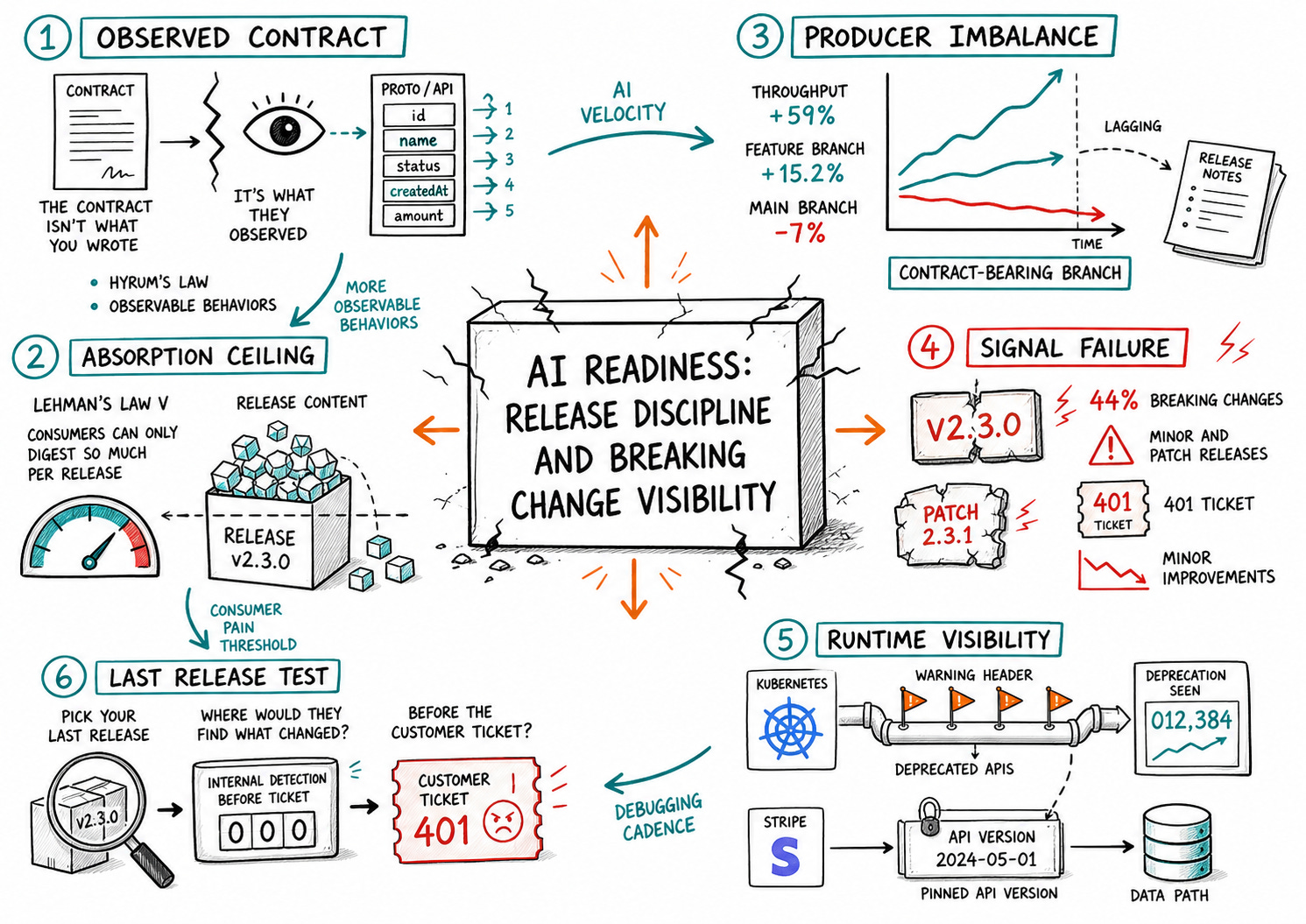
Hyrum Wright, then a Google engineer, made the observation that became known as Hyrum’s Law: “With a sufficient number of users of an API, it does not matter what you promise in the contract: all observable behaviors of your system will be depended on by somebody.” The canonical example is hash-table iteration order. Developers depend on undocumented ordering even when explicitly told not to. But the law generalizes far beyond APIs. It applies to error message formats, default behaviors, performance characteristics, the order of fields in a proto, the way an enum coerces to a string, the latency floor of a request. Anything observable becomes part of the contract once someone observes it.
The “sufficient number of users” qualifier fires at lower thresholds than most teams assume. You don’t need millions of consumers. You need enough. An internal microservices architecture has enough. A partner SDK with three integrators has enough. A CI pipeline that serializes job artifacts has enough. The moment two systems exchange data, observable behavior becomes contract.
This matters now because AI doesn’t just multiply commits. It multiplies observable behaviors. More generated code paths mean more variations in error handling. More velocity means more incidental patterns that consumers will, over weeks or months, come to depend on. The producer-side commit count climbs. The contract surface, defined by what consumers actually see, climbs faster.
The Quantitative Ceiling Nobody Talks About
Most engineers know “Lehman’s Laws” as a phrase. Few know that the fifth law is an empirical claim, not a maxim.
Meir Lehman published Programs, Life Cycles, and Laws of Software Evolution in Proceedings of the IEEE in September 1980. Law V, Conservation of Familiarity: “During the active life of a program the release content (changes, additions, deletions) of the successive releases of an evolving program is statistically invariant.” Releases stayed roughly the same size, year after year, system after system. He measured it. The data is in Table II of the paper.
Why did releases stay bounded? Lehman gave the answer directly: the law “arises from the nonlinear relationship between the magnitude of a system change and the intellectual effort and time required to absorb that change.” Consumers can only digest so much per release. Producers, sensing the limit, stopped trying to ship past it.
The invariant held because production rate and absorption rate were balanced. AI broke the producer side. The consumer side, which is humans reading release notes, partner teams updating integrations, customers re-pinning dependencies, has not changed. Lehman’s Law V is being violated at the publication boundary. The violation is not regulated by anything except the consumer’s pain threshold.
Where the Imbalance Shows Up
Two distinct angles, both empirical, both pointing at the same boundary.
Producer-side acceleration. CircleCI’s 2026 State of Software Delivery report analyzed 28.7 million workflows across 22,000 organizations. Throughput climbed 59% year over year, mostly driven by AI-generated code. But the gain landed unevenly. For the median team, feature-branch throughput grew 15.2%, while main-branch throughput, the contract-bearing branch consumers actually see, fell 7%. The most productive single team in the dataset was running 136,000 workflows a day, roughly ten times the 2024 leader. The codebase is accelerating. The branch the release narrative describes is moving slower or shrinking.
The release notes are being written for a smaller, slower output than the code generation suggests. The consumer sees one number. The producer is operating at another.
Now turn the lens around. AI is not just a producer of contract changes. It is also a consumer of contract state. And it gets contract state wrong.
In LLMs Meet Library Evolution at ICSE 2025, Wang and colleagues tested seven LLMs across 145 API mappings from eight Python libraries, totaling 28,125 completion prompts. They measured the rate at which each model wrote code using already-deprecated APIs when there was a documented replacement available. They called it the Deprecated Usage Rate. Across the models, the overall rate ranged from 25% to 38%. When the prompt context was outdated, the rate climbed to between 70% and 90%. Even when the new API was right in front of the model in the up-to-date context, the rate stayed at 9% to 18%. The model could not reliably override its memorized version of the contract.
The producer’s AI generates contract changes faster than consumers can absorb them. The consumer’s AI reads stale contracts and writes new code against them. Both errors hit the same publication boundary, from opposite directions. The producer ships a change the consumer can’t see. The consumer’s tools can’t see the change either, even when handed the new contract.
The Detection Channels Don’t Catch What Falls Through
The producer’s defense, when this happens, is usually the same. We have tests. We have semver. We have a changelog. The data on each is uncomfortable.
Venturini and colleagues, in TOSEM 2023, ran the largest empirical study of breaking-change manifestation in the npm ecosystem. They followed real consumer build failures back to the producer releases that caused them. About 12% of dependent packages and 14% of their releases were impacted by breaking changes during non-major updates of their dependencies. That alone is meaningful. The headline finding is sharper: of all manifesting breaking changes, 44% were introduced in both minor and patch releases. The releases that, per the SemVer specification, are not allowed to contain breaking changes.
SemVer is the consumer’s primary contract for “is this safe to upgrade?” Nearly half the time, the answer is wrong.
Generalize back to the cold open. The 401 ticket. The reordered proto. The “minor improvements” release note. The producer wasn’t lying. They genuinely didn’t see the change as breaking, because the formal definition of breaking didn’t include “fields the consumer’s deserializer is observing in a particular order.” Hyrum’s Law makes that change a break. SemVer makes it a patch. The customer experiences both.
AI doesn’t invent this gap. It widens it. Each “small refactor” lands as a patch. Each one passes internal tests. Each one carries a Hyrum’s-Law-shaped change the producer didn’t see, because what’s documented is not what consumers depend on.
The Discipline That Scales
If documentation channels can’t keep up with AI tempo and detection channels miss half the breaks, what’s left?
Two examples sit at different points on the same spectrum. Both engineered the visibility into the runtime, not the changelog.
Kubernetes has supported thousands of consumers across hundreds of vendors for more than a decade. Its API deprecation policy is explicit and operates in the data path. GA APIs cannot be removed within a major version. Beta APIs require nine months or three minor releases of deprecation, whichever is longer, before removal. Calling a deprecated REST endpoint emits a Warning header in the response (RFC 7234, Section 5.5). The runtime tells the consumer at the moment of the call. An apiserver_requested_deprecated_apis Prometheus metric increments every time a deprecated endpoint is hit, with labels for group, version, resource, and the release in which the API will be removed. Platform teams can see deprecation usage on a dashboard.
The runtime broadcasts what the documentation can’t keep up with.
Stripe sits at the opposite end of the same spectrum. Stripe has not shipped a breaking change since 2011. The first time a customer makes an API call, their account is pinned to whatever API version is current that day. Every subsequent response is walked backward through self-contained version-change modules until it matches the contract that customer signed up for. The customer never has to detect the change because the change never reaches them. Stripe’s official upgrades policy enumerates what is not a breaking change in five short bullets. Adding a new resource. Adding an optional parameter. Adding a property. Reordering properties in a response. Adding a new event type. The list is short, specific, and not subjective.
Kubernetes broadcasts every change at runtime. Stripe hides every change from old consumers at runtime. Different mechanisms, same principle: visibility is engineered into the data path, not delegated to a release note arriving in someone’s inbox at exactly the right moment.
Most teams cannot build a Stripe-grade transformation system or a K8s-grade deprecation infrastructure. The mechanism is not the lesson. The principle is. Visibility surfaces have to operate at the same tempo as code generation. A Slack notification when a public function signature changes. A header that tags every response with the schema version. A metric that counts requests against endpoints the team intends to retire. The implementation scales with the team’s situation. The principle does not.
Pick Your Last Release
Pick your last release. If a downstream consumer wanted to know what changed and whether it affects them, where would they find that, without asking you?
If the answer is “the changelog,” when did you last verify it covers what AI actually shipped this week? If the answer is “the version number,” Venturini’s 44% says the version number is wrong nearly half the time. If the answer is “they’ll find out when something breaks,” that’s not a release discipline. That’s a debugging policy.
The diagnostic isn’t whether you write release notes. It is whether your release discipline operates at the tempo your producer side is now generating changes at. Pre-AI, narrative discipline could keep up. Post-AI, the math doesn’t work. Either the visibility is engineered into the runtime, or the contract is being silently rewritten on every commit and your consumers are absorbing the rewrites by hitting them.
There is one quiet test that captures the rest. The next time something breaks for a downstream consumer, count how many people inside your organization were involved in detecting it before the customer ticket arrived. If the answer is zero, you don’t have a release discipline. You have a debugging cadence shared with your customers.
Back to 8:47 AM
AI didn’t lower the cost of breaking changes. It hid the breaking changes inside changes that don’t look like breaks. The producer ships at velocity. The consumer reads at the same speed they always did. The release note is accurate, in a clinical sense, and useless. Hyrum’s Law fires somewhere downstream. Lehman’s Law V cracks at the publication boundary. The customer’s CFO calls.
Either your runtime tells your consumers what changed. Or the next Monday-morning ticket does
.