
Before we talk about prompts, models, agents, or “AI transformation,” we need to talk about something far less glamorous.
Your repository structure.
Most organizations skip this conversation entirely. They install a coding assistant, hope for a 40% productivity jump, and then wonder why the AI keeps hallucinating about services it has never seen. As if giving someone a telescope and pointing it at a wall would improve their astronomy.
Here’s the thing: GenAI systems are brutally literal. They do not understand your architecture diagram. They do not respect your org chart. They do not intuit tribal knowledge. They operate on context, whatever files, contracts, dependencies, documentation, and signals you make available.
And your repository model defines that context.
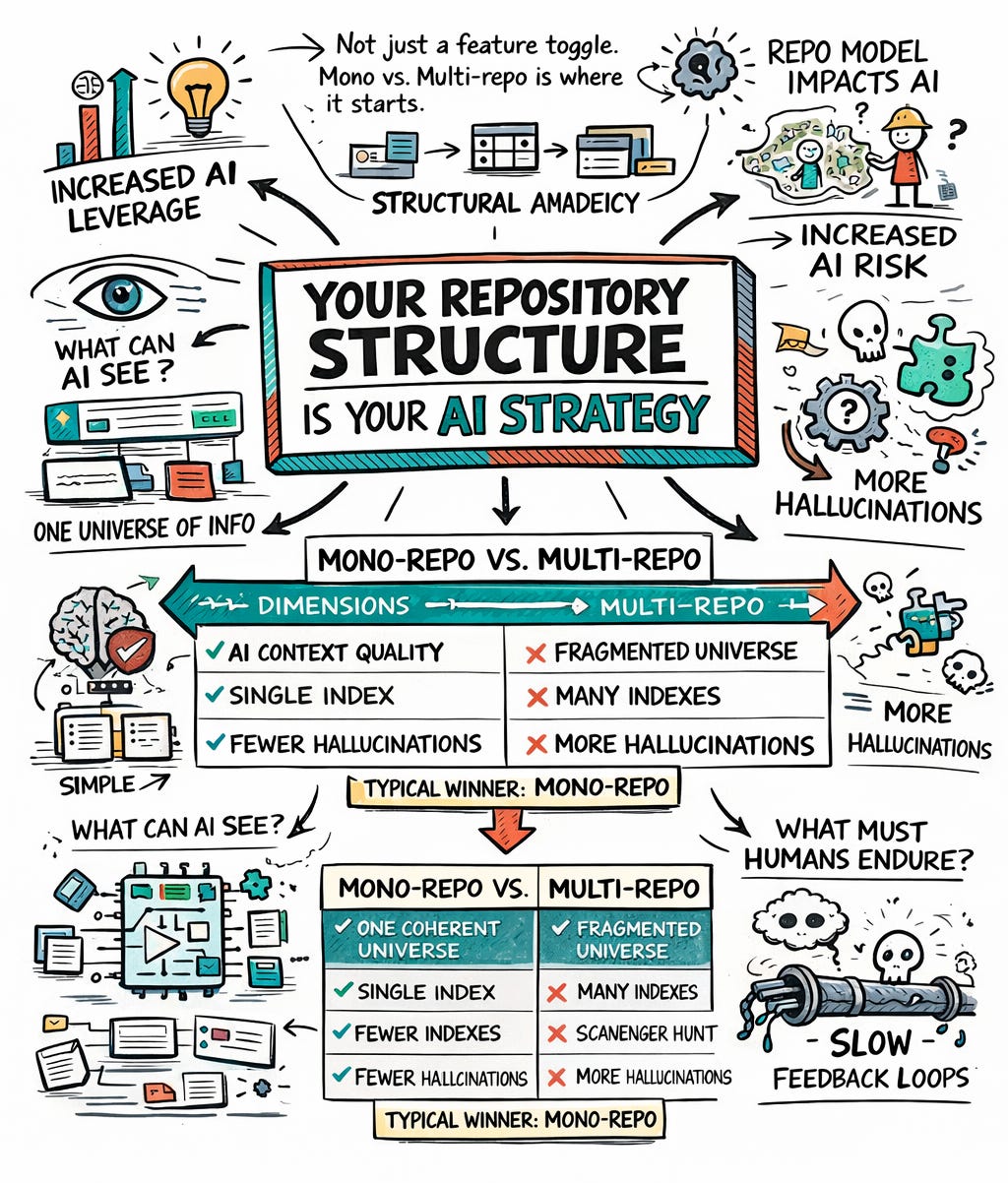
Mono-repo vs multi-repo is not an engineering preference. It directly influences how much of your system AI can “see,” how reliably it can propose cross-service changes, how much hallucination risk you introduce, and how quickly feedback loops close.
Some organizations extract enormous value from GenAI because their structural foundation reduces ambiguity and fragmentation. Others bolt AI on top of a fragmented repo landscape and are surprised when suggestions are inconsistent, incomplete, or dangerously confident.
AI doesn’t create clarity. It amplifies whatever clarity or chaos already exists. I’ve written about this before: AI didn’t break software development. It exposed what was already broken. Your repo structure is no exception.
So the question isn’t “mono or multi?” The question is: does your repository model increase AI leverage or increase AI risk?
That question plays out across three dimensions: what AI can see, what AI can change, and what humans have to live with regardless.
How Much Can Your AI Actually See?
Models don’t reason about your system, they reason about the context you give them.
A mono-repo gives AI one coherent universe. No model reads your entire repo at once, context windows and file selection still limit what fits. But in a mono-repo, the right context is available to select from. In multi-repo, it may not exist in scope at all. The model can traverse services, shared libraries, config files, migrations, ADRs, tests, all reachable in one workspace. When it proposes a change, it “sees” downstream impact more often. It understands naming conventions better. It hallucinates less because fewer pieces are missing.
Multi-repo setups fragment that universe. Now the AI operates on partial truth unless you build serious retrieval plumbing. Without a strong RAG layer (retrieval-augmented generation feeding relevant code into the model’s context before it responds) stitching repositories together, the model makes confident statements about code it has never seen.
That’s not stupidity. That’s statistical optimism.
Retrieval is where the difference becomes painfully concrete. Mono-repo? One index. One embedding strategy. One semantic search layer. Multi-repo? Multiple indexes, multiple connectors, multiple drift vectors. Each repo can silently diverge in structure, conventions, and documentation quality.
Onboarding is another one. If AI is a junior developer that needs onboarding, then multi-repo is like sending that junior to five different offices on day one with no map. Ask an AI to “explain how authentication flows through the system.” In a mono-repo, it can trace the story end-to-end. In a multi-repo world, you get a treasure hunt. Partial answers. Missing contracts. “It seems like this service might...” is not what you want when someone just joined your team.
Agent reliability follows the same pattern. The more fragmented the context, the more the AI fills in blanks. I ran this experiment: multiple AI agents working in parallel across a codebase. Each agent confidently reproduced a different version of the past. None of them knew which future we were aiming for. That was in one legacy code repo. Now imagine that fragmentation multiplied across dozens. Outdated README? Missing interface? Version mismatch? Congratulations, you just manufactured hallucinations at scale.
And then there’s CI signal. AI thrives on tight feedback loops. As I wrote in When AI Made Speed the Wrong Problem: when systems stop screaming, organizations stop learning. If your CI setup supports targeted tests and affected-graph builds (running only the tests and builds impacted by a given change) in a mono-repo, the model gets fast, meaningful validation. If it doesn’t, your pipeline becomes a slow monolith and productivity dies.
Multi-repo pipelines are naturally scoped per service, which can be fast. But cross-service integration feedback becomes harder. The AI may “pass” locally in one repo while silently breaking another. Multi-repo isolates the screams.

What AI Can See Is One Thing. What It Can Change Is Another.
Seeing the system is necessary. But the real cost shows up when AI needs to change something that crosses service boundaries.
Most systems don’t fail because a single service is bad. They rot because change needs to cross boundaries. A new field in an API. A renamed event. A shared library update. A security patch touching five services. That’s where the repo model either accelerates you or turns every improvement into a coordination ritual.
AI is extremely good at mechanical change: renaming fields everywhere, updating call sites, migrating from library v1 to v2, refactoring patterns across dozens of files, generating consistent policy, lint, and test updates. But only if it can see the whole system.
Take a concrete example. You need to rename userId to accountId across the API gateway, two downstream consumers, the shared schema, the migration scripts, and the monitoring dashboard.
In a mono-repo, that’s one branch, one MR/PR, one CI run. The AI updates every call site, every test, every doc reference in a single atomic move. Done. Mechanical transformations become boring, which is exactly what you want.
In a multi-repo setup, the same change becomes choreography. Update the gateway repo. Publish a new schema version. Update consumer A. Update consumer B. Hope CI pipelines are aligned. Update the dashboard repo. Coordinate releases. Pour yourself a coffee. Check Slack. And somewhere in that dance, someone forgets to update the OpenAPI file or the README. The AI confidently claims everything is aligned until production proves otherwise.
Refactors tell the same story. GenAI loves big, repetitive structural work. Extract interface. Replace framework. Introduce new error model. In mono-repo, this is a surgical strike. In multi-repo, it’s a diplomatic mission with version numbers.
Dependency management is where entropy sneaks in. One source of truth keeps version drift under control. Multiple repos drift. AI suggestions start breaking because the dependency graph in one service is three minor versions behind another. The model isn’t wrong, your landscape is inconsistent.
Standardization follows the same logic. Lint rules, templates, policy-as-code, testing conventions. Enforce once in mono. Recreate endlessly in multi. Humans tolerate slight inconsistencies. AI treats them as conflicting signals.
And documentation? I explored how PDSA loops make AI coding actually work and a key ingredient is persistent system memory at the repo root. A CLAUDE.md, an AGENTS.md, ADRs next to the code they describe. When architecture docs live next to code and change in the same PR, drift reduces. When they live somewhere else, summaries diverge. AI-generated explanations start contradicting reality. That’s when trust erodes.
Cross-service evolution is friction-heavy in multi-repo unless you are extremely disciplined with contracts, versioning, and automation. Mono-repo lowers that coordination friction. Multi-repo raises the discipline requirement.

And Then There’s the Part That Has Nothing to Do With AI — Except It Does
No matter how advanced your GenAI agents are, they still operate inside the structure you designed. That structure either supports clear thinking or it forces people to wrestle with the system before they even touch the code. The choices you make for humans end up shaping what AI can do, whether you intended it or not.
Start with build and test scope. In a mono-repo, laziness is brutally visible. Without smart scoping (affected graphs, targeted test runs, incremental builds) every small change triggers a rebuild of the universe. Developers wait. Agents wait. CI bills grow quietly in the background. Multi-repo reduces that pain by default. Smaller repositories mean smaller pipelines and faster local feedback. But the trade-off shows up later, when cross-service integration becomes a coordination exercise and problems surface late.
Boundaries behave differently as well. In a mono-repo, everything is right there. Visibility increases collaboration, but it also lowers friction. When something works and sits a few folders away, people will use it. Not because they are reckless but because it is easy. Multi-repo introduces structural friction. Crossing a boundary requires intent. That slight resistance often protects architectural integrity better than any governance document.
Security and access control follow the same pattern. A mono-repo centralizes access, which is efficient until sensitive domains demand isolation. Then you need mature permission management or you expose more than you intended. Multi-repo makes isolation straightforward. Lock down a service and you are done.
Tooling complexity shifts in subtle ways. Mono-repo centralizes conventions: one AI configuration, one lint configuration, one pipeline philosophy, one standardized way of working. It reduces duplication but demands repository hygiene. Multi-repo tends to multiply almost-identical scripts and pipelines. Over time, those “almost the same” setups diverge just enough to become a maintenance tax nobody planned for.
And then there is blast radius. In a mono-repo, the potential surface area of impact is larger. A mistake can travel far. In multi-repo, damage is naturally contained. Failures stay local until integration reminds you that boundaries relocate complexity rather than eliminate it.
These are not theoretical trade-offs. This is organizational physics. And every one of these human decisions: scoping, boundaries, security, tooling, shapes the environment your AI agents inherit.

When Multi-Repo Is the Right Call
Before this reads as a mono-repo manifesto, it isn’t. Grin.
There are scenarios where multi-repo is the smarter AI strategy. Regulated domains with hard data isolation requirements. Acquisitions where incompatible stacks must coexist before integration is even possible. Strict least-privilege environments where broad repo access creates more risk than fragmentation does.
In those cases, the coordination tax is a feature, not a bug. The structural friction protects things that matter more than AI convenience and benefits. The key is knowing you are paying that tax deliberately and not discovering it when the AI quietly drifts across a boundary it should never have crossed.
So Where Does That Leave You?
At this point, the question is no longer “mono or multi?”
It’s whether your current setup is helping AI reason about your system or forcing it to guess.
You don’t need a perfect structure. You need a structure whose weaknesses you understand.
If you are mono-repo:
Do you have scoped builds and affected-graph logic, or are you running the universe on every commit?
Are boundaries explicit and enforced, or are they social agreements that break under pressure?
If you are multi-repo:
Do you have a retrieval layer stitching repositories together?
Are contracts versioned and enforced, or tribal?
Can you perform cross-service change without turning it into a release coordination ceremony?
Whatever your answers are, AI will magnify them.
Engineering discipline matters more than any repo choice. But your repo structure determines how much discipline you need and how forgiving the system is when discipline slips. You cannot compensate for structural entropy with better prompts.
So before investing in more models, more licenses, more agents, ask yourself: where does your repository model reduce ambiguity? Where does it create it? Where does it hide it?
AI readiness is not about adopting tools. It is about removing friction that makes intelligence unreliable. As I recently argued: AI didn’t become smarter. It became more predictable. And predictability requires structure.
Mono or multi does not decide your success.
Structural clarity does.
And if you are unsure which one you have, that uncertainty is already part of your assessment score.
Now go look at your repos. Before the AI does it for you and writes a very polite, very wrong summary of what it found.