

Open the backlog item at the top of your team’s queue right now.
Read it as if you’d never met your team. As if you didn’t know your domain. As if you couldn’t ping the PM in Slack to clarify what they meant. As if you’d be evaluated solely on whether the resulting code does what the ticket says, with no opportunity to ask follow-up questions.
That is exactly what your AI coding agent does every time it picks up a ticket.
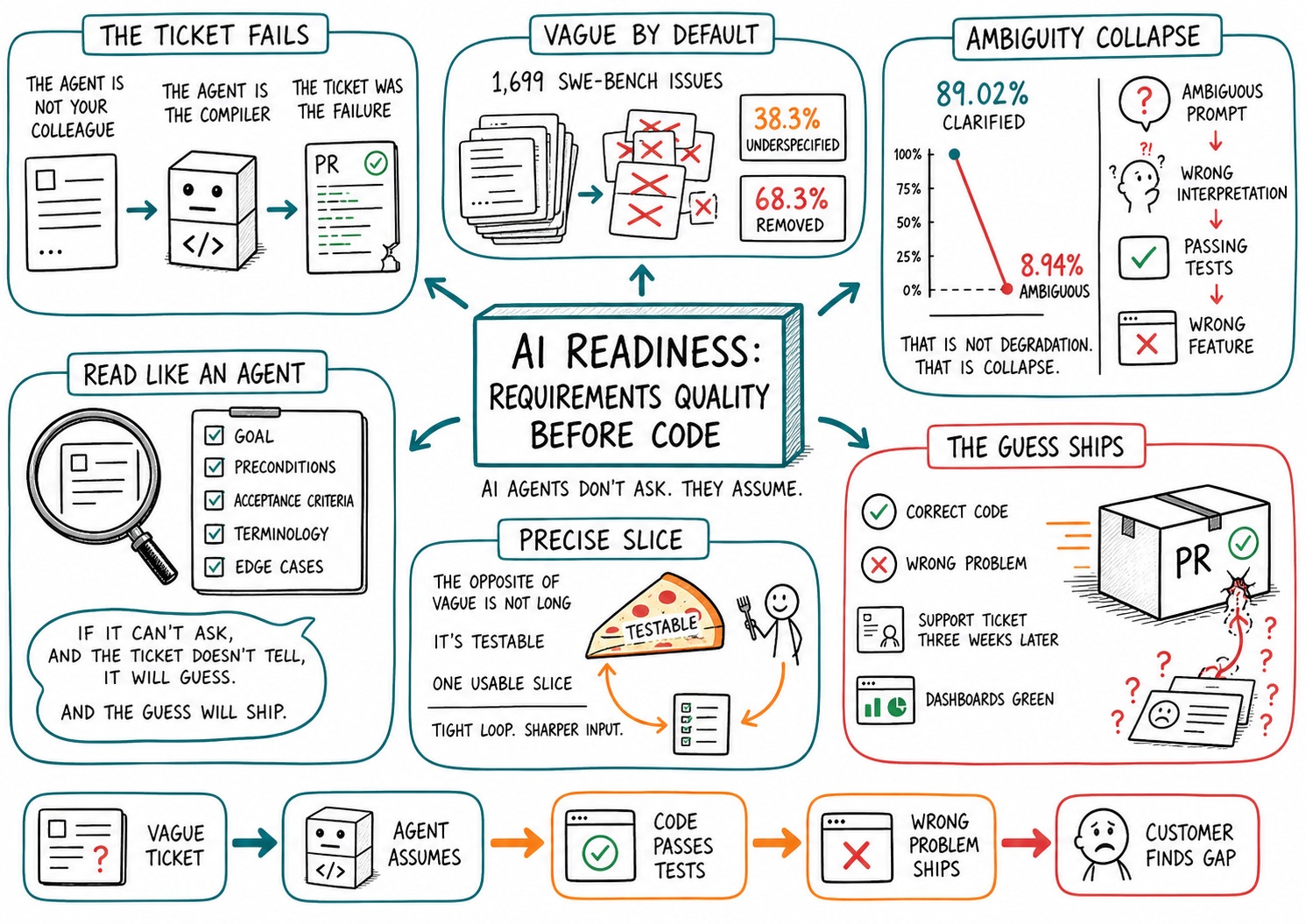
If you’d be uncertain about the goal, so is the agent. If you’d want to ask about edge cases, so does the agent. The difference is that you, presumably, would ask. The agent will pick an interpretation, write fluent code against that interpretation, generate tests that pass against that interpretation, and ship a clean-looking PR. Three weeks later, support gets the ticket from the customer who experienced the gap.
The PR didn’t fail. The reviewer didn’t fail. The team didn’t fail. The agent did exactly what was asked.
The ticket was the failure.
The Backlog You’re Handing the Agent
This isn’t a hypothetical. We have measurements now.
In August 2024, OpenAI ran a quiet but important annotation campaign. Ninety-three experienced Python developers manually screened 1,699 randomly selected issues from SWE-bench, the standard benchmark for AI coding agents. The issues were real bug reports from active open-source projects, written by working developers for working developers. The kind of tickets your team writes every day.
Of the 1,699 samples, 38.3% were flagged for underspecified problem statements at severity 2 or 3, severe enough to be filtered out as inadequate. Combined with other quality issues, 68.3% of the original SWE-bench was removed before the team would publish a benchmark they’d stand behind.
Sit with that for a second. Nearly four in ten real GitHub issues, written by senior engineers in production projects, were judged by other senior engineers to be too vague to fairly evaluate code generation against. And those weren’t the worst-of-the-worst. Those were a random sample.
Your top backlog item right now is more likely to look like the filtered-out 1,200 than the curated 500.
This is not because your team is sloppy. It’s because backlog items have always been written for colleagues who could ask follow-up questions in Slack. They were prompts for a conversation, not specifications for a compiler. The tradition is older than your codebase. It worked because the next step in the workflow involved a human who would push back when something didn’t add up.
The agent is not your colleague. The agent is the compiler.
The Default Is Assumption
The next thing the data tells us is uncomfortable. Given an ambiguous prompt, AI coding agents do not pause. They proceed.
In April 2025, Wu and colleagues built HumanEvalComm, a modified version of the HumanEval benchmark that injects three kinds of imperfection into otherwise solvable problems: missing information, contradictory information, and ambiguous information. They measured how often state-of-the-art code-generation models stop to ask for clarification before generating code.
The answer, across the field, was that models generate code in over 63% of ambiguous scenarios without seeking clarification. Baseline DeepSeek Coder asks for help on ambiguous prompts 24.12% of the time. The other 75.88% of the time, it picks an interpretation and ships.
The interpretation is plausible. The code compiles. It often passes tests, because the tests were generated by the same model holding the same misunderstanding. None of that is the same as solving the problem the user actually had.
Edwards and Schuster, at the University of Vienna, named the failure mode directly in their March 2026 paper: “Existing agents are optimized for autonomous completion rather than interactive collaboration.” This isn’t a model bug. It’s a training objective. The agent is doing exactly what it was trained to do.
How much does the not-asking cost? More than anyone has been willing to admit out loud.
In March 2026, Li, Wu and Chang published ClarEval, a benchmark that takes coding tasks GPT-4o solves cleanly, then injects three flavours of ambiguity: missing goal, missing premise, ambiguous terminology. Same task. Same model. Same code generation logic. The only thing that changes is the precision of the brief.
GPT-4o’s pass rate falls from 89.02% on the clarified task to 8.94% on the ambiguous one.
That is not a degradation. That is a collapse.
Reasoning ability didn’t help. Larger context windows didn’t help. Better prompting didn’t help. What helped was knowing what to build. The single biggest variable in AI code quality is not the model you picked. It’s whether the brief you gave it contained the answers.
Misalignment Is the Problem, Not Bad Code
This reframes the entire conversation about AI code quality.
Most engineering leaders, when they hear “AI is getting things wrong,” reach for solutions on the model side or the review side. Better prompts. Smarter agents. Stricter linting. More careful PR review. All of that helps at the margins. None of it touches the failure that ClarEval just measured.
In April 2026, Jia Li and collaborators from Wuhan University, NTU, and several other institutions published a paper with a thesis line that should be on every engineering leader’s whiteboard:
“LLMs can fundamentally misunderstand the requirement, rather than merely making mistakes during reasoning or code writing.”
Their requirement-alignment-first system, REA-Coder, didn’t try to make the model smarter. It tried to make sure the model and the user were solving the same problem before any code was generated. First-generation outputs improved by 210.44% on the APPS benchmark and 344.67% on xCodeEval. Stronger reasoning didn’t get those numbers. Better post-hoc repair didn’t get those numbers. Aligning on the requirement before generation got them.
The dominant failure isn’t bad code. It’s correct code solving the wrong problem.
The Faros 2026 Acceleration Whiplash report, with telemetry from 22,000 developers and 4,000 teams across two years, lands on the same diagnosis from the industry side. Their tenth and final recommendation is unambiguous: “AI agents cannot derive intent by looking at the current state of a codebase. The codebase is just a point in time.” Intent doesn’t live in the code. It lives in the spec. And if the spec doesn’t carry intent, nothing downstream can recover it.
This is structurally different from the problems an earlier article in this series covered around naming consistency inside code. That article looked at the words in your repository at a point in time. This one looks at the words in your tickets, before any code exists. The naming inside your code can be cleaned up by a refactor. The misalignment between a vague ticket and a confidently-built feature can’t, because the system that used to clean things up afterward (refactoring) collapsed alongside everything else AI accelerated, as a previous article in this series documented.
The brief enters the system. The code comes out. There is no quiet correction in the middle anymore.
“But Modern Agents Already Ask”
This is where the natural objection arrives, and it’s a fair one. Anthropic’s own data, drawn from 500,000 Claude Code sessions between late 2025 and early 2026, shows that Claude has been deliberately trained to push back. On the most complex tasks, Claude Code stops to ask for clarification more than twice as often as humans interrupt it. The capability is real. The trajectory is real. It’s getting better.
So why are we still shipping the wrong feature?
Because the asking has a hard ceiling, and it isn’t on the agent’s side.
Every clarification question is an interruption to a developer. The whole point of using an agent is that the developer isn’t writing the code. If the agent has to stop and ask ten questions to compensate for a vague ticket, the developer is now answering ten questions per ticket, which is the bottleneck the agent was supposed to relieve. After about three of those questions, most developers learn to type “use your best judgement” and walk away.
That’s what the ceiling looks like in practice. It isn’t the agent’s training. It’s the developer’s tolerance.
Anthropic can keep training Claude to ask better questions, and that helps. But the ceiling on agent-asking is bounded by human attention. The ceiling on better-specs is bounded only by team discipline. The second ceiling is much higher, and the lever to raise it doesn’t require a model release.
It requires that the brief, when it reaches the agent, already contains the answers.
Precision Per Slice, Not Per Product
This isn’t an argument for waterfall. It isn’t an argument for hundred-page specifications. It isn’t an argument for trying to enumerate every requirement of an entire system before anyone writes a line of code.
Nobody can write a precise specification for an entire product up front. The honest answer to “what should happen if a customer cancels” is a list of edge cases that nobody can fully enumerate in advance, because some of them only become visible once the first version is in front of users. That’s been true since the first agile manifesto, and it hasn’t stopped being true.
The opposite of vague isn’t long. It’s testable. A precise backlog item describes one usable slice of behaviour, in enough detail that the resulting code can be tried by a human and judged against the ticket. Not the whole product. Not even the whole feature. The next slice a user can actually use.
This is where iterative development matters more now, not less. You don’t enumerate every edge case up front. You ship a small, precise slice. A human tries it. The next ticket gets written with what was learned. Then the next slice. Tight loop, short feedback, real users in front of the work.
What changes under AI is the per-slice discipline, not the iteration count. Pre-AI, a vague slice cost a few hours of human friction before anything shipped. Post-AI, a vague slice ships with the agent’s assumptions baked in, before any human has a chance to push back. So the slices have to stay small, and each one has to leave the agent less to guess about. Tighter loop. Sharper input.
The teams getting this right aren’t writing more specifications. They’re writing more usable products, one precise slice at a time.
The Diagnostic: One Backlog Item, Read Like an Agent
This is something you can do today, before you finish reading this article. Pick the backlog item at the top of your team’s queue right now. Open it. Read it as if you were an AI agent that has never met your team, doesn’t know your domain, can’t ask follow-up questions in Slack, and will be evaluated solely on whether the resulting code does what the ticket says.
Then run five checks.
1. Goal. Is the high-level objective explicit and testable? “Improve the cancellation flow” is not a goal. “Cancel a subscription such that no further charges are issued, with the customer’s last paid billing period honoured, refunding any prorated amounts” is a goal. Could the agent generate a test from your goal alone, or would the test require it to invent its own definition of success?
2. Preconditions. What state is the system in when this triggers? What state must hold before the action is valid? What is explicitly out of scope? Most backlog items are silent on this. The author assumed everyone knew. The agent doesn’t know. The agent guesses.
3. Acceptance criteria. Are the criteria written so that they convert directly into tests? An earlier article in this series argued that test meaningfulness, not test coverage, is the real measure of quality. That argument lives or dies upstream of here. Vague acceptance criteria produce vague tests, which produce green dashboards on systems that do the wrong thing.
4. Terminology. Are the domain terms used in the ticket consistent with the codebase’s vocabulary? Or did the author quietly invent a synonym? “Cancel,” “deactivate,” “suspend,” “terminate” and “close” are not interchangeable in a billing system, but a backlog item written in fifteen minutes between meetings will treat them as if they are. The agent treats them as the author wrote them.
5. Edge cases. Are the edges enumerated, or is the agent expected to invent them? A typical six-line user story will leave at least half a dozen edges implicit. Each one ships as an assumption. Some of them ship as a customer support ticket three weeks later.
If a senior engineer on your team would read the backlog item and immediately have to ping the PM in Slack to answer any of these, the agent has the same gap. The difference is that the senior engineer asks. The agent assumes, and the assumption ships.
The diagnostic isn’t whether your team uses INVEST stories or EARS-syntax requirements or Gherkin acceptance criteria. Those are tools. Tools you can adopt cheaply. The diagnostic is whether the actual ticket at the top of your queue today, written by an actual person on your actual team, contains the answers an agent would need before generating code. If it doesn’t, that’s where your AI readiness ceiling is set. Not at the model. Not at the IDE. Not at the review process.
At the ticket.
What Changed, Exactly
For two decades, requirements quality was treated as an upstream concern that mattered, but rarely felt urgent. Vague stories caused friction. Developers asked questions. Reviewers pushed back. Misunderstandings surfaced as bugs and got patched. The system absorbed bad specs, slowly and expensively, but it absorbed them.
Three things made that absorption possible. None of them survives AI velocity.
The first was that developers asked clarifying questions before writing code. The agent generates instead. The clarifying step is gone unless someone explicitly engineers it back in.
The second was that reviewers caught misunderstandings before merge. As an earlier article in this series documented, reviewers are now drowning in PRs that are 51 to 154 percent larger than they were a year ago. They approve what they cannot fully evaluate. The catch step is degraded.
The third was that refactoring teams realigned implementation with intent over time. Refactoring activity, as a previous article in this series covered, has collapsed to its lowest level in five years. The slow correction is gone too.
The brief enters the system. The code comes out. Nothing in the middle pushes back anymore.
This is why the spec is suddenly an engineering artefact and not a Slack-conversation starter. Pre-AI, vague specs caused expensive friction. Post-AI, vague specs cause shipped product. The friction was always doing more work than anyone gave it credit for.
What You’re Actually Asking the Agent
The PR won’t fail. The reviewer won’t fail. The team won’t fail. The agent will do exactly what the ticket says.
The system you’ve built around the agent will work perfectly by every internal metric. Code generated from natural language, fast, high success rate. Dashboards green. Velocity up. The backlog moving.
And somewhere downstream, three weeks from now, a customer will hit the gap between what the ticket said and what the business needed. They won’t file a bug against the model. They won’t blame the agent’s training data. They’ll file a ticket against the feature. By then, the brief that caused it will have rolled off the top of the queue and into the archive nobody reads.
The compiler did its job. The compiler was given the wrong source.
The teams getting the most from AI right now are not the ones with the fastest agents or the most expensive context windows or the cleverest prompt-engineering tricks. They’re the ones whose backlog items leave the agent nothing to guess about, sliced small enough that a user can try the result and tell you what to write next. That’s not glamorous work. It is the highest-impact work available, because every other investment downstream of it is bounded by the quality of what enters at the top.
Go back to the backlog item you opened at the start of this article. Read it once more, like an agent reading it cold.
If it can’t ask, and the ticket doesn’t tell, it will guess.
And the guess will ship
.