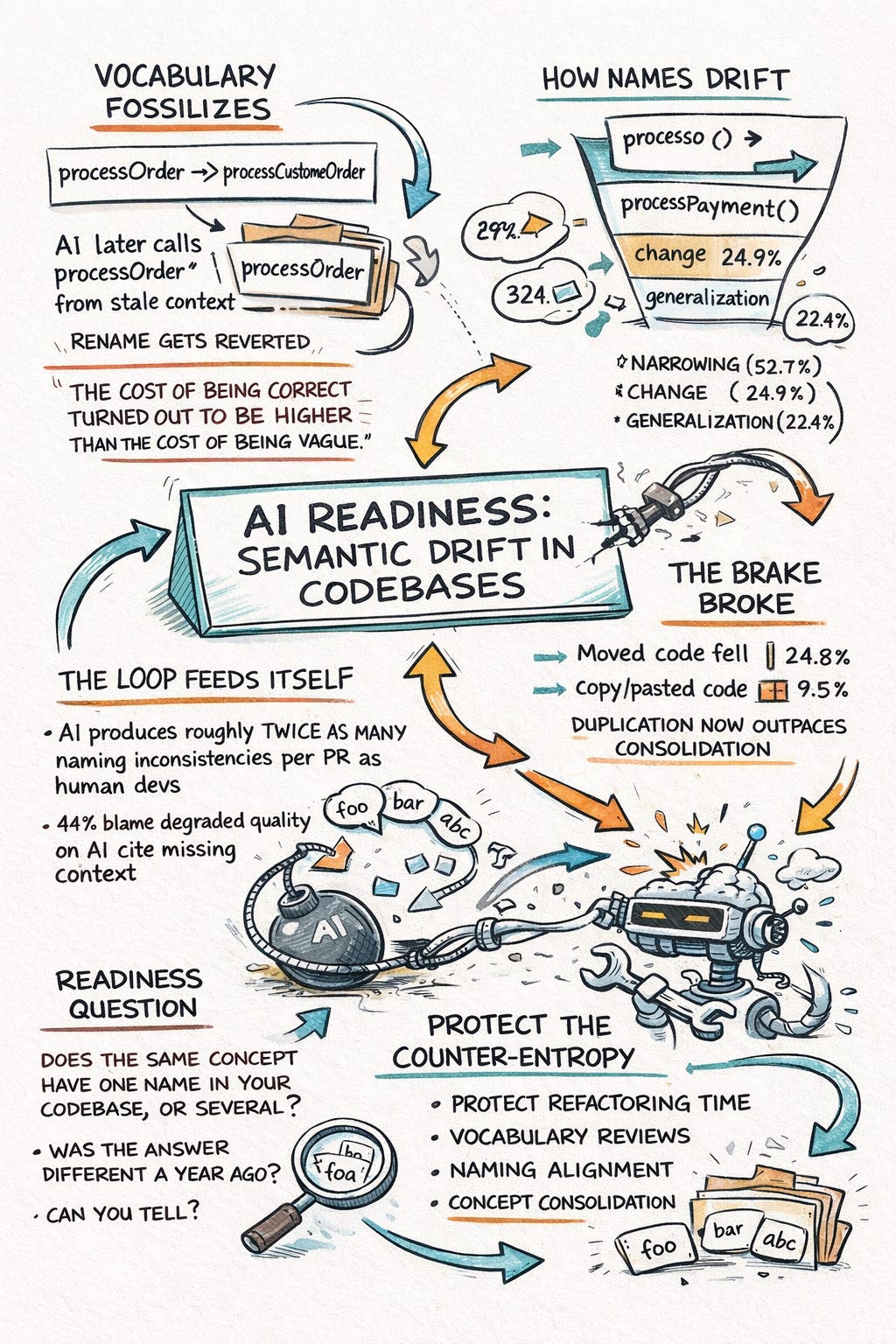

A developer renames processOrder to processCustomerOrder in the checkout module. The function specifically handles customer orders, not vendor orders. The rename is correct. It makes the code honest.
A week later, an AI coding assistant generates new code in the fulfillment module. It calls processOrder. It found the name in an older import, a cached dependency graph, a code example three directories away that hadn’t been updated yet. The function doesn’t exist anymore. The build breaks. Two teams spend a day debugging.
The fix: one team reverts the rename. Not because the original name was better. Because the downstream dependency was invisible, and the cost of being correct turned out to be higher than the cost of being vague. The codebase now has a method named too generically for its context, and a team that learned a lesson it will never unlearn.
Don’t rename things. Don’t consolidate. Don’t improve. Leave the vocabulary alone.
I’ve watched this happen. Not once. Repeatedly. A team improves a name, something breaks downstream, the rename gets reverted, and the team learns to stop trying. The vocabulary fossilizes not because anyone decided it should, but because the cost of improving it exceeded the cost of tolerating it. That lesson is the drift engine. Every team that stops aligning its vocabulary is surrendering to a force older than software itself.
In the earlier article on domain language consistency, we established that naming inconsistency is measurable harm: brain imaging showed it increases cognitive load, and projects with naming-behavior mismatches see 29% more bugs. That was a snapshot. This is the cost over time.
The question isn’t whether your naming is inconsistent. It’s whether it’s getting worse. And how fast.
Software Naming Decays Like Thermodynamics Predicts
In 1980, Meir Lehman published what became known as the Laws of Software Evolution, derived from decades of studying IBM’s OS/360 development. His Second Law is blunt: “Complexity increases and structure deteriorates under change, unless work is done to maintain or reduce it.”
Lehman wasn’t reaching for a metaphor when he compared this to thermodynamics. He meant it literally. Software systems, like physical systems, tend toward disorder. Every change increases entropy unless counter-entropy work is applied. We’ve known this for 45 years. We keep being surprised by it.
Most people read that law and think about architecture. Module coupling. Dependency graphs. But naming is structure too. The vocabulary of a codebase is as much a structural property as package boundaries or API contracts. The terms it uses for domain concepts, the consistency of those terms across modules and services: all of it decays under exactly the same forces.
David Parnas identified the mechanism in 1994. “Programs, like people, get old,” he wrote, and named two causes: failure to adapt, and the changes themselves. The second cause is the one that matters here. Changes made by people who don’t fully understand the original design intent cause structural deterioration.
Every new developer, every new team member, every rotation, every contractor arrives without the full context of why things are named the way they are. They introduce alternative terms. Not out of negligence, but because they’re solving a problem with the vocabulary they brought, not the vocabulary the codebase evolved.
This was the slow leak. Naming coherence decaying at the rate of human turnover and institutional memory loss. Manageable, because teams had senior developers who remembered the naming decisions, and refactoring practices that periodically consolidated the vocabulary back toward coherence.
When Eick et al. tracked a Bell Labs switching system over 15+ years, analyzing millions of lines of code, they found what Lehman and Parnas predicted: “mixed, but on the whole persuasive, statistical evidence of code decay,” corroborated by the developers who lived through it. Changes grew harder over time. Structure deteriorated under change. The system aged.
That was the baseline. The human-era rate of decay. The rate that AI changed.
How Names Actually Drift
The entropy argument is convincing in theory. But until recently, nobody had measured how names actually change over time in real codebases.
Wang et al. changed that in 2025. They mined commit histories across real-world Java projects and classified every naming inconsistency by how it emerged. The result is the first empirical taxonomy of naming drift.
Three types. The most common, at 52.7%, is narrowing: a name gets more specific in one location while staying generic elsewhere. process() becomes processPayment() in the checkout service. It stays process() in three other modules. Each narrowing decision is locally correct. The developer who renamed the function was right to do so. But the codebase now has two names for related concepts, and nobody updated the others because nobody knew they existed. Or because the cost of finding them exceeded the value of the rename.
The second type, at 24.9%, is change: the name shifts to an entirely different meaning. A function that once calculated shipping costs gets repurposed to calculate taxes, but keeps its original name. The name now lies. The third type, at 22.4%, is generalization: the name loses precision. A specific function gets reused for a broader purpose, but the name isn’t updated to reflect its expanded scope.
The ratio in real codebases: 1 inconsistent method name per 531 consistent ones. That sounds reassuring until you realize what it means at scale. In a codebase with half a million methods, that’s roughly a thousand naming inconsistencies. Each one invisible in isolation. Each one adding a small vote for a different vocabulary than the one that was intended.
And here’s what makes drift different from static inconsistency: it’s directional. Chaikalis and Chatzigeorgiou tracked feature scattering across 14 versions of JFreeChart and found it monotonically increases. The concept “line chart” was implemented across 73 classes in version 1.0.0. By version 1.0.13, it had spread to 87. One feature, growing from 73 classes to 87, with declining code reuse between them. Each new location potentially introducing its own naming conventions for the same domain concepts.
This never reverses on its own. Scattering only goes up unless someone actively consolidates. That’s Lehman’s Second Law playing out at the feature level: entropy increases unless work is done.
And the work mostly doesn’t get done. Arnaoudova et al. cataloged 17 types of linguistic antipatterns in code: methods that do more than their name says, getters that don’t return, names that contradict the implementation. When they notified developers of these inconsistencies in their own projects, only 10% led to code changes. Ninety percent persisted.
Not because developers disagreed. Because fixing a name has costs: broken dependencies, failed imports, confused downstream consumers. The costs consistently outweigh the perceived benefit of accuracy. Everybody agrees the name is wrong. Nobody has time to fix it. The backlog wins.
Each unfixed inconsistency becomes part of the codebase’s context for every future contribution. The vocabulary doesn’t just fragment. It sediments.
An analysis of 50,092 pull requests across 117 Java projects showed the ratchet in action: style-inconsistent PRs take longer to merge, but they still merge. Each one shifts the baseline slightly. No single PR causes the drift. The aggregate transforms the codebase. A thousand small votes, none of them wrong individually, all of them pointing in different directions.
The Brake That Broke
So far, this is a story about physics. Systems tend toward disorder. Names fragment over time. Fix rates can’t keep up with introduction rates. All of this was true before AI touched a single codebase. What kept it manageable was a specific kind of work: refactoring.
Not refactoring in the vague sense of “cleaning up code.” Refactoring in the structural sense: moving code to consolidate duplicates, renaming for consistency, collapsing multiple implementations of the same concept into a single canonical one. This was the counter-entropy work that Lehman’s law describes. The “work done to maintain or reduce” complexity. As long as refactoring kept pace with drift, the vocabulary stayed navigable. Not perfect. Navigable.
GitClear’s analysis of 211 million changed lines of code, spanning January 2020 through December 2024, shows what happened to that brake.
Moved code, the clearest proxy for refactoring activity, collapsed from 24.8% of all changed lines in 2021 to 9.5% in 2024. A 62% decline in three years. In the same period, copy/pasted code rose from 8.4% to 12.3%. In 2024, for the first time in GitClear’s recorded history, copy/pasted code exceeded moved code. Duplication now outpaces consolidation.
The numbers get worse from there. An eightfold increase in commits containing five or more duplicated code blocks during 2024 alone. Duplicate block prevalence roughly ten times higher than pre-AI baselines. Code churn rose from 3.1% to 5.7%. Newly added code went from 39.2% to 46.2% of all changes.
More code, faster, with less attention to what already exists. If you wanted to design a system for maximizing naming divergence, you’d struggle to beat this.
The report’s framing captures the mechanism precisely. AI-generated code resembles contributions from “an itinerant contributor, prone to violate DRY-ness.” An itinerant contributor doesn’t know the existing abstractions. Doesn’t know what’s already been named. Doesn’t know what vocabulary the codebase developed over years of domain modeling and team negotiation. They arrive, they add, they leave. They never consolidate, because consolidation requires exactly the kind of codebase-wide awareness that a context-window-limited AI assistant does not have.
“Compared to adding code, which requires only a single keypress,” the report notes, “code refactoring takes a lot of work. It requires baseline familiarity with the patterns being used across the repo.”
That’s the sentence that explains the refactoring collapse. Adding code is cheap. Tab-completing a suggestion is effortless. Refactoring requires understanding the whole. AI makes the cheap thing cheaper and the hard thing irrelevant. The counter-entropy work doesn’t just slow down. It disappears.
Every unconsolidated duplicate is a concept that now lives in two places, potentially with two names. Every copy is a potential naming divergence. And the mechanism that used to find and fix these divergences is running at less than half its pre-AI rate.
The report’s own warning lands heavily: “Instead of developer energy being spent principally on developing new features, in coming years we may find ‘defect remediation’ as the leading day-to-day developer responsibility.”
The Loop That Feeds Itself
This is where the snapshot from the domain language consistency article meets the time series.
That article established that AI produces roughly twice as many naming inconsistencies per PR as human developers, and that 44% of developers who blame degraded quality on AI attribute it to missing context. Those are point-in-time measurements. The temporal consequence is what makes them dangerous.
Each AI contribution learns from the current codebase context. The context already contains accumulated drift from every previous contribution. AI absorbs the drift and reproduces it, with additions. The output is merged. The context now contains the original drift plus the new contribution’s divergences. The next AI suggestion reads a slightly more fragmented vocabulary. And so on.
The velocity of drift increases with the amount of existing drift. The mechanism that used to break the loop, a developer who knew the domain well enough to refactor toward coherence, is being displaced by a tool that generates faster but never consolidates. The loop has no natural ceiling.
Why Nobody Notices
If naming drift is this pervasive, why isn’t anyone screaming about it?
Because it’s invisible at the scale where decisions get made.
Wang et al.’s 1:531 ratio means naming inconsistencies are rare enough per-method to pass any code review. No reviewer rejects a PR because calculateTotal should have been called computeOrderTotal. The inconsistency is too small to flag and too costly to fix. The drift is like water damage: undetectable in any given rain, catastrophic in aggregate.
Current detection tools don’t help much. Wang et al. tested existing deep-learning-based naming inconsistency detectors on realistic data and found they achieve 55-60% accuracy. Previous benchmarks had used 1:1 balanced datasets (equal numbers of consistent and inconsistent names), which inflated accuracy figures dramatically. On real data, where inconsistencies are rare, detection is functionally unreliable. And even when drift is systematic enough to be learned by ML models, those models require codebase-wide context to work. Most AI coding assistants see a file or a few files, not the naming history.
Architecture erosion follows the same pattern. De Silva and Balasubramaniam’s survey of architecture erosion research found that the problem is invisible until structural, and no single strategy addresses it. You need three simultaneous approaches: minimize (prevent drift at the source), prevent (enforce boundaries mechanically), and repair (regularly compare intent to reality).
That last approach suggests a practical exercise. Compare your intended domain vocabulary, the terms your team agreed on, to the actual terms in the codebase. If you even have an intended vocabulary. Most teams don’t. They have a Confluence page from 2022 with 14 views, three of which were bots. That’s the gap. And it’s growing.
Protect the Counter-Entropy
Here’s the readiness question: does the same concept have one name in your codebase, or several? Was the answer different a year ago? Can you tell?
Try this. Pick your most important domain concept. The one that appears in every service, every module, every API boundary. Search the codebase for it. Count the variants. Now run git log on when each variant was introduced. If the trend line is going up, that’s your drift rate. If it accelerated in the past year, you’re seeing the refactoring collapse in your own codebase.
The most valuable thing a team can do for AI readiness isn’t adding AI to more workflows. It’s protecting refactoring time. Refactoring is the only mechanism that counteracts naming entropy. Every sprint that trades refactoring for feature velocity is a sprint that lets Lehman’s law run unchecked. Every hour of consolidation prevented by the pressure to “ship faster with AI” is an hour of accumulated drift that will degrade every future AI suggestion.
The teams getting the most value from AI aren’t the ones generating the most code. They’re the ones maintaining naming coherence so that AI’s context stays clean enough to produce coherent output. They budget counter-entropy work: vocabulary reviews, naming alignment, concept consolidation. Not because it’s tidy. Because it’s the input quality that determines whether AI-generated code integrates or fragments.
You can’t outrun entropy with velocity. You can only outwork it with discipline. And right now, the discipline is losing.