

Your AI strategy has a 120 million blind spot.
That’s not a metaphor. IBM’s Institute for Business Value did the math: for a 20-billion enterprise putting 20% of IT spend into AI, technical debt adds more than 120 million per year in hidden implementation costs.
Per year. Hidden. In the business case the board already approved with enthusiastic nodding.
Most organizations don’t account for this. Not a line item. Not a footnote. Not even a sheepish asterisk next to the ROI projections. The assumption, stated in boardrooms, implied in roadmaps, whispered like a prayer during sprint planning, is always the same.
AI will clean it up.
It’s a comforting belief. It’s also the organizational equivalent of maxing out a credit card because you’re pretty sure you’ll get a raise next quarter.
The debt doesn’t care about your strategy. It compounds regardless.
The Cure That Feeds the Disease
Here’s the trap nobody talks about in AI strategy meetings.
CIO.com calls it a “classic catch-22”: generative AI creates new technical debt at unprecedented velocity while simultaneously being positioned as the solution to manage it. The tool that’s supposed to fix the problem is making the problem worse. And the faster you deploy it, the deeper the hole gets.
If you’ve spent any time in software development, you recognize the underlying pattern. “We’ll refactor later.” “We’ll clean it up in the next sprint.” “We’ll address the debt when things slow down.” Things never slow down. The refactoring never happens. And now the same promise has been dressed up for the AI era: deploy fast, let AI sort out the mess.
Except the mess was already enormous before AI entered the picture.
Every organization has that codebase. The one where onboarding a new developer takes weeks, not because the domain is complex, but because the code has accumulated years of shortcuts, workarounds, and “temporary” fixes that became permanent the moment nobody had time to revisit them. Multiply that by every service, every team, every system and you start to understand what $1.52 trillion in accumulated software technical debt looks like from the inside. That’s the US alone.
McKinsey estimates it consumes 20 to 40 percent of the entire technology estate’s value — with 10 to 20 percent of the budget earmarked for new products quietly rerouted to keeping the lights on in systems nobody wants to touch but everybody depends on.
This is the foundation your organization is building its AI strategy on. And it’s sinking.
Forrester projects that three out of four technology decision-makers will face moderate-to-high debt severity by 2026 driven not by neglect, but by adoption. Carlos Casanova, Forrester’s Principal Analyst, calls it “a perfect storm of technology growing, companies being far more distributed and AI coming into the equation, which will make the problem exponentially worse.”
So here you are. Sitting on a trillion-dollar structural liability, adding an engine that generates more of it, and hoping the same engine will eventually circle back to clean up after itself. At AI speed, “later” arrives before “now” is even finished.
The Speedometer Is Lying
In July 2025, a research organization called METR ran an experiment that should have been reassuring. They gave 16 experienced open-source developers access to the best AI coding tools available — Cursor Pro with Claude — and asked them to complete real tasks in real codebases. Not toy projects. Repositories averaging ten years old, over a million lines of code, with 22,000+ GitHub stars. The kind of systems that most enterprises actually depend on.
The result was supposed to confirm what everyone already believed: AI makes developers faster.
It didn’t. Developers using AI took 19% longer to complete their tasks.
That alone would be worth a raised eyebrow. But the study’s real finding is worse. Before the experiment, developers predicted AI would make them 24% faster. After the experiment and after being measurably slower, they still believed they’d been 20% faster. They experienced the slowdown and didn’t notice it.
Let that sit for a moment. Your developers genuinely believe they’re accelerating. The data says they’re not. And nobody’s raising the alarm because the people doing the work can’t feel the problem.
Meanwhile, the behavioral shift is already visible in the data. GitClear analyzed 211 million changed lines of code and found that refactored lines — code that gets restructured for long-term health — collapsed from roughly 25% in 2020 to less than 10% by 2024. Developers aren’t just working slower. They’ve quietly stopped doing the housekeeping that prevents debt from piling up. Adding code is easy now. Improving code? That still requires understanding.
Picture what this looks like inside a real organization. A senior engineer at a mid-size retailer asks AI to add a new promotion rule: “Buy 2 Get 1 Free” with loyalty tier exclusions. The generated code compiles, passes the happy-path tests, and ships fast. Everyone’s impressed.
Then reality shows up. A loop that looked redundant turns out to be a workaround for a vendor API that times out under load. A “legacy” guard clause exists because loyalty tiers are cached inconsistently across services. A test passes locally but fails in the integration suite that nobody runs before lunch.
The engineer spends twice the time reviewing, adapting, and rejecting chunks of generated code but skips the refactor that would make the promotions engine understandable for the next person. Why would you refactor? AI made the change feel cheap. Ship it. Move on.
This is how you end up making staffing decisions, capacity plans, and delivery commitments based on a productivity gain that exists only in everyone’s heads. The speedometer says you’re going 120. The actual speed is 80. And nobody checks because the dashboard looks right.
Compounding, Not Accumulating
Traditional technical debt is annoying but manageable. You skip a test, defer a refactor, take a shortcut to hit a deadline. It adds up. You know roughly where it is. Given enough time and willpower — admittedly rare commodities — you can pay it down.
AI debt doesn’t work like that. It compounds.
Ana Bildea, writing for LeadDev, identifies three vectors that make AI-generated debt structurally different from everything that came before and unlike traditional debt, they don’t just coexist. They feed each other.
The first is model versioning chaos. A pipeline bug doesn’t just affect one release. It multiplies across every model retrain, every data refresh, every automated decision downstream. One defect doesn’t cause one problem. It causes the same problem, slightly mutated, in every system that touches it.
The second is code generation bloat. AI produces code at a volume that outpaces human review capacity. Not because reviewers are lazy but because there’s simply too much. When output exceeds the organization’s ability to evaluate it, low-quality code enters production unchecked. It’s not a quality control failure. It’s a throughput mismatch.
The third is organizational fragmentation. Teams inherit AI-generated systems they didn’t write, don’t fully understand, and can’t confidently modify. The reasoning that a human developer would naturally carry — why this pattern, what constraint, why this workaround — never gets captured when code is generated rather than authored.
Ox Security’s “Army of Juniors” report, which analyzed over 300 open-source repositories, found the fingerprint of all three. Their conclusion: AI-generated code is “highly functional but systematically lacking in architectural judgment.” Not occasionally lacking. Systematically. Avoidance of refactors showed up in 80 to 90 percent of AI-generated code. Narrow solutions that can’t be reused, each variation requiring fresh code — at the same rate. These aren’t bugs. They’re the default setting.
Here’s what compounding looks like when it plays out. Return to that retailer with the promotions engine.
Week one: the AI-assisted promotion change ships. It works. Nobody refactors. Why would you, when adding code feels this cheap?
Week three: the personalization model retrains. A subtle schema drift changes how a feature flag gets interpreted. The “quick fix” is another AI-generated defensive layer — written fast, reviewed slowly — that quietly becomes a dependency for every future retrain. The bug isn’t a one-time event. It’s a multiplier.
Week five: because AI makes it easy to add “just one more helper,” the codebase now quietly contains three pricing calculators and two validation layers. Nobody’s sure which one is authoritative. Every new change carries a higher review burden, not because the changes are complex, but because the system has become incomprehensible.
Week eight: a reorg splits Checkout and Loyalty into separate teams. Both inherit surfaces they didn’t design. AI continues to accelerate their changes — without shared intent — so inconsistencies harden into “the way the system works.”
What started as one patch is now a system where every change is slower, riskier, and harder to reason about. That’s not accumulation. That’s compound interest and nobody’s making payments.
The Spreadsheet Meets the Codebase
At some point, the story always leaves engineering and enters the boardroom. Here’s how it usually goes.
The board-approved AI program — personalization, AI-assisted customer support, whatever the flavor of the quarter — budgets for licenses, infrastructure, and headcount. The business case projects strong ROI. What it doesn’t account for is the cost of building on a foundation that’s actively sinking.
Month one looks fine. Month two, the engineering roadmap quietly shifts. “Stabilization work” appears: CI fixes, test failures, integration hardening, a sprint devoted to “paying down some technical debt.” Nobody calls it that on the board slide. It shows up as “unexpected implementation complexity.” Same thing, friendlier font.
Engineering feels the drag first. Finance discovers it later as missed dates, change requests, and a revised timeline that nobody in the original business case saw coming.
IBM’s Institute for Business Value surveyed executives across industries in November 2025, and the numbers strip away every comfortable assumption. 86% say technical debt constrains AI success and 81% say it’s not a future risk but a current reality, already limiting what their AI initiatives can deliver.
The financial mechanics are brutal. Debt remediation alone can consume up to 29% of AI implementation budgets. Nearly a third of the money earmarked for AI goes to fixing what should have been fixed before AI entered the picture. Projects that skip foundational work face 15 to 22 percent longer timelines, a 30-month AI rollout quietly becoming a 36-month slog. And when organizations ignore debt entirely, returns drop 18 to 29 percent, turning what looked like strong margins into marginal outcomes.
But here’s the number that should reframe every AI investment discussion: enterprises that fully account for tech debt costs in their AI business cases project 29% higher ROI than those that don’t.
Not because honesty magically shrinks the debt. Because honest projections lead to realistic timelines, appropriate budgets, and expectations that survive contact with the actual codebase.
If your AI business case doesn’t carry a line item for debt remediation, it’s not a business case. It’s a screenplay.
The Small Truth Hiding a Big Evasion
This is the part where someone in the room says: “But we’ve seen AI clean up legacy code. It works.”
They’re not entirely wrong.
In one case study reported by CIO.com, CGI used AI-assisted migration to achieve roughly 50% reduction in an application’s overall technical debt, with nearly 70% of new code generated and reused. That’s a real result, not a vendor slide.
So yes, AI can be used to pay down debt. Under controlled conditions, with clear architectural intent, and with humans making every meaningful decision about what to keep, what to kill, and what’s a workaround that only looks like debt.
But “AI can help with debt” and “AI will clean it up” are two very different sentences. The first is a tool selection. The second is an excuse to avoid making hard choices.
Three things AI cannot do, no matter how good the model gets.
It can’t infer context. A retry mechanism that looks like dead code might be the only thing preventing a race condition that surfaces once a month on the busiest night of the quarter. A database query wrapped in three layers of indirection might exist because a compliance audit in 2021 required field-level access logging that nobody remembers but everyone depends on.
It can’t understand business decisions. Technical debt often exists because someone made a trade-off, ship fast for the market window, accept the mess, deal with it later. Those decisions live in conversations and hallway negotiations, not in codebases. AI sees the code. It doesn’t see the reasoning.
It can’t follow principles it was never taught. AI follows examples. If your codebase has three inconsistent patterns for the same operation, AI will faithfully reproduce all three. At scale. With confidence.
Most organizations don’t even have the basics that would make AI-assisted remediation viable: no shared definition of what technical debt means, no consistent way to measure it, no clear plan for addressing it. AI can’t execute a strategy that doesn’t exist.
Here’s my take, and I’ll say it plainly: AI is leverage. Leverage amplifies discipline and it amplifies denial. If you treat debt as “later,” AI just makes “later” arrive faster and cost more.
Three Moves Before You Accelerate
If the argument so far feels like bad news, here’s the pivot: the organizations that get this right don’t just avoid the trap. They build a compounding advantage that makes every subsequent AI initiative cheaper, faster, and less risky.
One: Quantify debt financially, not technically.
Stop treating technical debt as an engineering concern that finance doesn’t need to understand. Put it in the AI business case, in dollars, not story points.
IBM’s data makes this straightforward: organizations that account for tech debt in their AI business cases project 29% higher ROI. The act of naming the problem changes how you plan for it. Timelines get realistic, budgets get appropriate, and expectations survive contact with the actual codebase.
Back at our retailer: the “personalization + AI support” program gets rewritten. The remediation budget is explicit and not buried in “contingency.” The ROI model includes a sensitivity analysis: what happens if the promotions engine stays unstable and every change still requires heroics? The board doesn’t love the revised number. But at least it’s a number they can plan around, not a fiction they’ll discover six months in.
Two: Stop the bleeding before accelerating.
This is the uncomfortable one. It means telling the board that the AI rollout needs to account for foundational work. It means accepting that going slower now is the fastest path to sustainable returns.
The Forrester data is unambiguous: debt severity is rising because of AI adoption. Adding more AI-generated code on top of unresolved structural problems doesn’t create progress. It creates an exponentially more expensive cleanup.
The retailer pauses net-new promotion features for one cycle. They stabilize CI, remove the worst coupling seams, and add constraints for the pricing engine: tests must be meaningful, duplication must be reduced, boundaries must be explicit. It feels slow. It is slow. It’s also the last time it will be this cheap to fix.
Three: Use AI for debt remediation with human architectural judgment.
This is where AI earns its keep. Not as a magic wand, but as a power tool in the hands of someone who knows what they’re building.
AI can identify patterns across a million-line codebase faster than any human team. It can automate migration. It can scaffold tests. CGI proved this. But humans must decide what matters, why code exists, and which patterns to keep.
The retailer points AI at the work humans avoid under pressure: migration, repetition removal, test scaffolding. Meanwhile, the architects define the invariants that AI can’t infer: one promotion calculator, one eligibility source of truth, explicit boundaries between Checkout and Loyalty, and a deliberate “delete more than you add” bias.
What changes isn’t just the codebase. It’s the trajectory. The next AI initiative inherits a healthier foundation. And the one after that inherits a better one still. 80% of executives agree: remediating debt in one initiative improves ROI of related future initiatives. The investment compounds positively in exactly the way that ignoring debt compounds negatively.
The Most Expensive Shortcut
“AI will clean it up” is the most expensive sentence in enterprise IT. Not because the cleanup never happens but because by the time you realize it’s needed, the cost has compounded beyond what any tool can fix.
Organizations that account for debt project 29% higher ROI. Organizations that ignore it watch returns drop 18 to 29 percent. Same technology. Same market. Same opportunity. Radically different outcomes.
The differentiator isn’t the AI. It’s whether you built something worth accelerating.
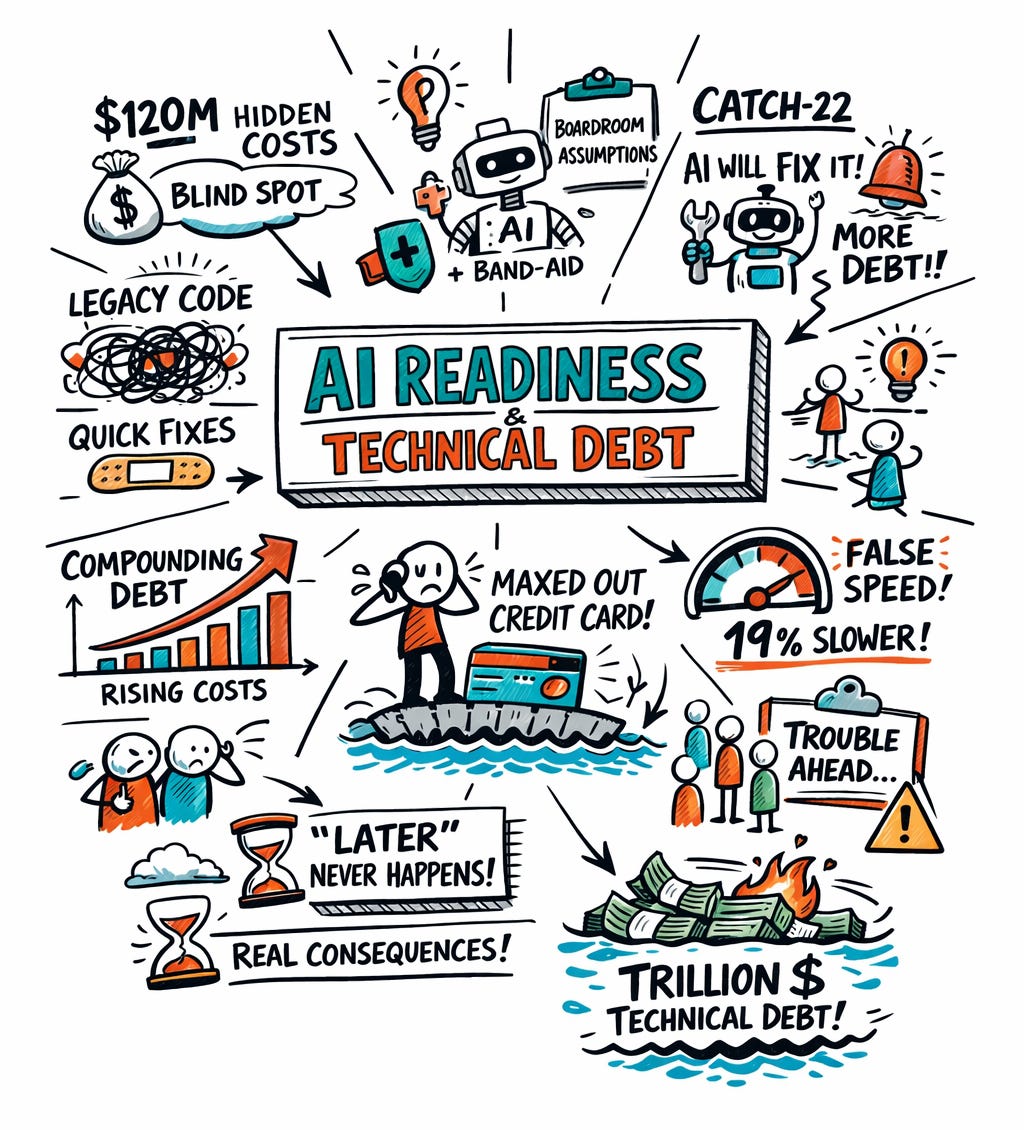
The METR study is the part that should worry leadership. Developers using AI took longer and didn't even notice. If your team believes they're getting faster but the data says otherwise, you're making capacity plans based on a feeling. That's not strategy, it's wishful thinking.