

A two-week feature branch. Three developers. AI-assisted. Every one of them producing more code, faster, than they ever have.
The branch grows. Trunk (or main) grows too, at the same accelerated rate. Neither notices the other.
Sprint ends. Merge time. The diff is 4,200 lines against a trunk (or main) that moved 6,000 lines in the same period. Half the conflicts are in files that were AI-generated, then modified, then modified again. The developer resolving them didn’t write any of the conflicting code. The AI did. On both sides.
Two days of merge resolution. A subtle bug in the resolution that surfaces in staging. A hotfix that requires another merge into a trunk (or main) that kept moving while everyone was untangling the last one.
Nobody on this team did anything wrong. They wrote code. They committed. They followed the same branching strategy the organization has used for years. The strategy just wasn’t designed for the velocity they’re now operating at.
If AI doubled the rate at which your codebase changes, how long can a branch safely live?
The Asymmetry Nobody Addressed
Every organization that adopted AI coding assistants changed how code gets written. Almost none changed how code gets integrated.
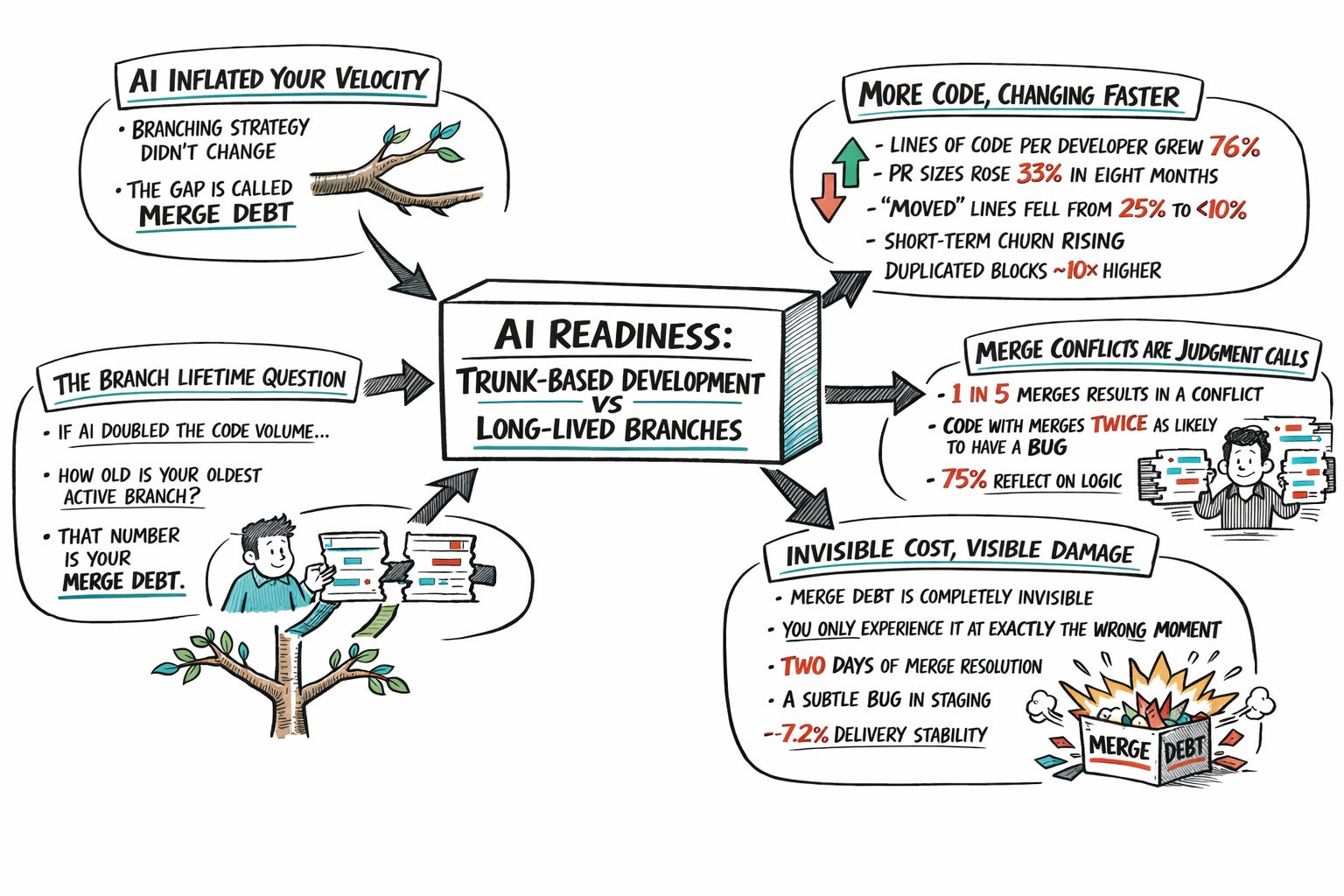
Think about what actually shifted. GitClear’s analysis of 211 million changed lines shows refactoring collapsing: “moved” lines fell from 25% of changed lines (2021) to <10% (2024). It also shows short-term churn rising (lines reverted or substantially revised within two weeks) and a sharp rise in duplicated blocks (measured as ~10× higher prevalence in 2024 than two years prior). Greptile measured the volume side: lines of code per developer grew 76%. PR sizes rose 33% in eight months.
More code. Changing faster. Duplicated more. Cleaned up less. That’s the new production baseline.
Now think about how that code integrates. The same way it did before AI. The same feature branches. The same unforced two-week lifetimes. The same merge-at-the-end-of-sprint pattern. Nothing changed on the integration side. The branching strategy was designed for a velocity that no longer exists.
Go back to our three developers. Each of them is producing 76% more code than a year ago. More of that code gets revised quickly, and duplication makes the conflict surface area wider. On the other side of the branch, trunk (or main) is changing at the same accelerated rate because every other team got the same velocity boost. The branch and trunk are diverging at AI speed, and nobody notices until someone tries to bring them back together.
This is where the intuition breaks down. Most developers think of merge conflicts as occasional friction. A file changed on both sides, you pick the right version, you move on. Kasi and Sarma studied 143 open-source projects and found the actual rate: 1 in 5 merges results in a conflict requiring human intervention. That’s the pre-AI baseline. And here’s the finding that should worry anyone running long-lived branches: code associated with merge conflicts is twice as likely to have a bug. In 75% of conflict cases, the developer needs to reflect on program logic to resolve it. These aren’t trivial formatting collisions. They’re judgment calls made under time pressure on code the resolver often didn’t write.
At pre-AI velocity, 1 in 5 was manageable. Annoying, but survivable. At AI velocity, with more files changing per developer, higher churn within those files, and more duplication across files, the surface area for conflicts on any branch that lives longer than a few hours expands dramatically. The merge that was “usually fine” becomes a structural risk.
DORA’s 2024 report measured the system-level consequence: a 25% increase in AI adoption correlated with a 7.2% decrease in delivery stability. Not because the AI wrote bad code. Because organizations increased production without increasing integration frequency. They widened the on-ramp without adding lanes.
Merge Debt
Every hour a branch lives, the delta from trunk grows. Under AI acceleration, it grows faster. That growing delta has a name: merge debt.
I use this term deliberately. Technical debt, which we explored in an earlier article in this series, is about code quality degrading over time. Merge debt is different. It’s the accumulating cost of deferred integration. And it has a property that makes it more dangerous than technical debt: it’s completely invisible.
No dashboard tracks merge debt. No metric captures it. No alert fires when a branch has been diverging for eight days. It exists only as a growing probability: the probability that the eventual merge will be painful, error-prone, and introduce bugs. You can’t see it. You can’t measure it. You only experience it at exactly the wrong moment, when the branch attempts to merge.
Go back to our team. Their two-week branch was accumulating merge debt from the first hour. Every commit on the branch increased the delta. Every commit on trunk increased it too. But nobody felt the weight because the debt is silent while the branch is open. It announces itself on merge day. Two days of resolution. A bug in staging. A hotfix cycle. That’s what merge debt looks like when it comes due.
And it doesn’t grow linearly. More files change on both sides, creating more potential conflict points. Higher churn means files that conflicted yesterday may conflict differently today. Code clones mean a fix in one place doesn’t propagate to the duplicate on the branch. Each factor multiplies the others. This is compounding, not accumulation.
In Navigating Complexity of Cognitive Load in Software Product Development, Viktor Grgić and I frame both continuous integration and trunk-based development as cognitive load practices, not just engineering preferences. This is a distinction worth pausing on. Long-lived branches impose cognitive overhead on every developer who must track divergent states. What’s on trunk? What’s on the branch? Which version has the latest fix? Did someone already patch that bug on trunk, or only on the branch? These questions eat mental bandwidth that should be going toward the actual work.
Trunk-based development eliminates this by maintaining a single source of truth. One version of the code. No parallel realities to track. The cognitive load of “where is the real state of the system?” drops to zero.
Under AI acceleration, this cognitive burden gets worse in a way most teams underestimate. Our three developers aren’t just tracking their own branch against trunk anymore. They’re tracking a branch where the AI generated code they didn’t fully author, against a trunk where other teams’ AI generated code they’ve never seen. The developer resolving the merge isn’t just resolving code conflicts. They’re reconstructing weeks of parallel history across two codebases that diverged at AI speed, written partly by machines on both sides.
Many teams don’t even realize they’re carrying this debt. In our book, we call out the CI jargon problem: teams confuse “having a CI server” with practicing continuous integration while maintaining long-lived branches that integrate weekly at best. They believe they’re doing CI. They’re running a pipeline. That’s not the same thing. Continuous integration means integrating continuously. If your branches live for days or weeks, you’re doing periodic integration with automated builds. The distinction matters because one eliminates merge debt and the other lets it pile up behind a reassuring green dashboard.
The business cost shows up in DORA’s performance clusters. Elite performers deploy on demand with less than one hour recovery and roughly 5% change failure rate. Low performers deploy monthly with one-week-plus recovery and roughly 40% change failure rate. The gap is 182x in deployment frequency and 2,293x in recovery time. Branch lifetime is one of the structural factors that separates these clusters. Merge debt doesn’t show up on the dashboard. It shows up in the gap between these numbers.
It Already Works at Scale
The immediate objection is always scale. “Trunk-based works for small teams. We have hundreds of developers. We can’t all commit to the same branch.”
Google has 25,000 developers committing to a single trunk.
Potvin and Levenberg, writing in Communications of the ACM, documented the numbers: ~2 billion lines of code, 9 million unique source files, and ~40,000 commits per workday (about 16,000 by humans and another 24,000 by automated systems). Google works trunk-based; long-lived branches with parallel development on branch and mainline are “exceedingly rare.” The infrastructure behind it is serious: custom repository tooling, automated presubmit checks, and a workflow designed for small changes integrated constantly.
Microsoft runs the same model. Several hundred developers per repository, 200+ pull requests merged to trunk per day, feature flags decoupling deployment from feature exposure. Their assessment: working from a single trunk “virtually eliminates merge debt.”
That phrase is worth sitting with. Virtually eliminates. Not “reduces.” Not “manages.” Eliminates. By making branches so short-lived that the delta from trunk never grows large enough to matter.
The structural pattern both share: small increments, frequent integration, automated validation, feature flags. Neither tolerates branches that live for days, let alone weeks.
What makes these examples relevant isn’t that Google and Microsoft are exceptional organizations doing exceptional things. It’s that they built these integration disciplines before AI coding assistants existed. They were designed for high human velocity. AI velocity makes them not just preferable but necessary.
Think about what our three developers’ sprint would have looked like under this model. Instead of a two-week branch accumulating 4,200 lines of divergence, each developer integrates to trunk multiple times per day. The delta never exceeds a few hours of work. Conflicts surface when they’re small, when the context is fresh, when the developer who wrote the code is the one resolving the conflict. The two-day merge nightmare at the end of the sprint never happens because the debt never accumulates.
Now consider where most organizations actually stand. AWS reported in January 2026 that 77% of organizations deploy once per day or less, with 20% deploying only monthly or quarterly. Meanwhile, 90% of developers now use AI coding assistants. That’s AI-level velocity feeding into pre-AI integration cadence. The distance between those two numbers is where merge debt accumulates, invisibly, in every long-lived branch across the organization.
The Branch Lifetime Question
AI didn’t break your branching strategy. It exposed that the strategy was already operating near its limit. The branches that were “fine” at human velocity become structural liabilities at AI velocity. The merges that were “manageable” become two-day ordeals. The debt that was invisible stays invisible right until it isn’t.
The highest-leverage response isn’t better merge tooling or smarter conflict resolution. It’s shortening branch lifetimes to hours. Making integration so frequent that merge debt never accumulates. This isn’t a git configuration change. It’s an organizational design decision about how work flows from development to integration. It requires feature flags, automated testing that runs in minutes, and a discipline of small increments that feels uncomfortable until you see what it prevents.
DORA’s research defines the practice: three or fewer active branches, lasting no more than a few hours, merging to trunk at least once a day. No code freezes. No integration phases. The organizations that treat branching as infrastructure, not developer preference, will absorb AI velocity. The rest will pay merge debt they never saw coming.
This isn’t about copying Google or Microsoft. It’s about recognizing a structural constraint. If AI doubled the code volume flowing through your organization and you changed nothing about how that code integrates, you didn’t get faster. You got further behind.
How old is your oldest active branch? Now multiply by the rate AI is changing your codebase. That number is your merge debt. And it’s growing every hour.
PS: maybe stacked diffs can also help, yet, if you can work like that why not TBD?