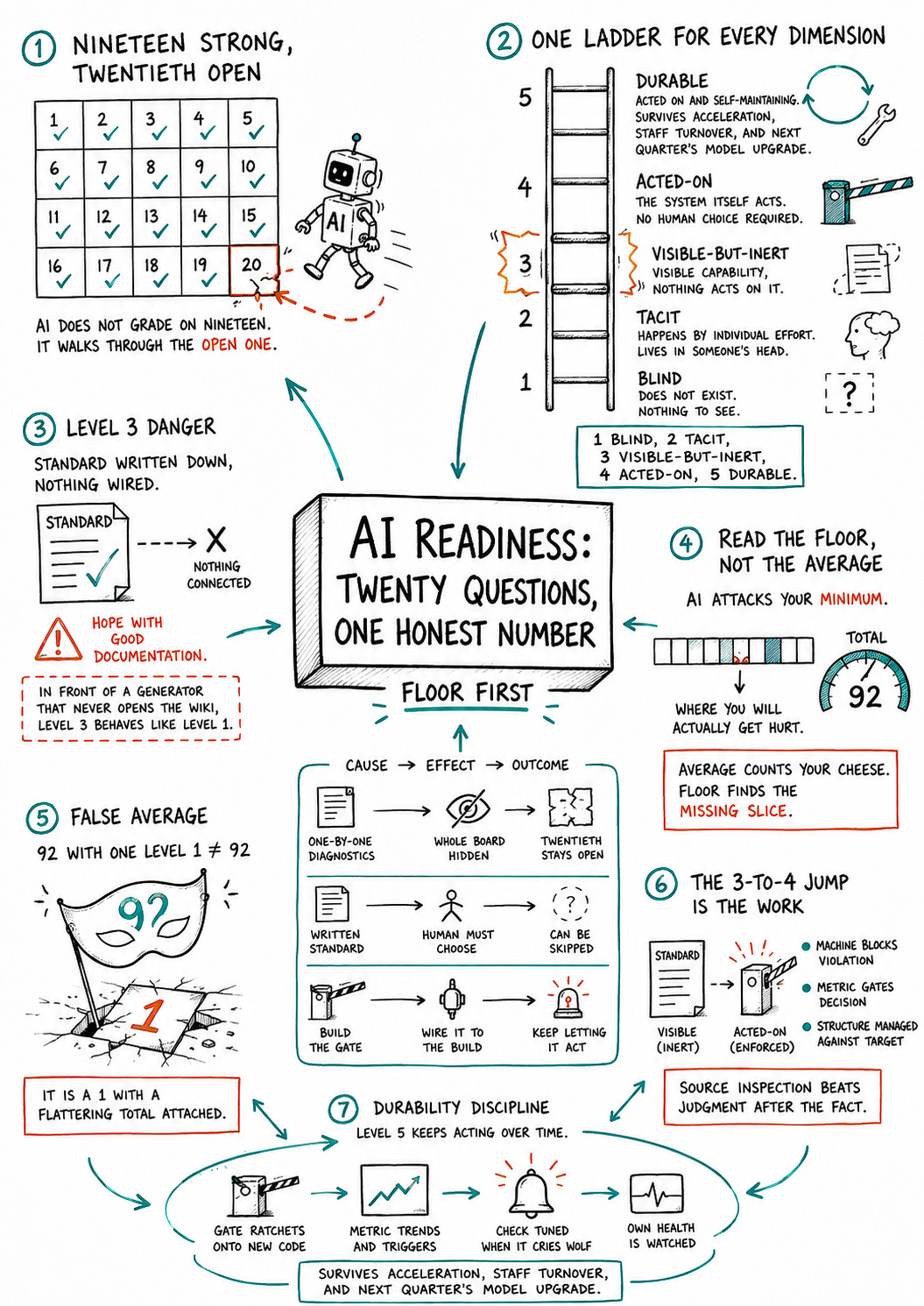

You have spent twenty AI Readiness articles answering twenty diagnostic questions, one at a time. Violate a boundary on purpose and watch what fails. Ask three teams what a “customer” is. Name the standard you keep repeating in review. Each felt survivable on its own.
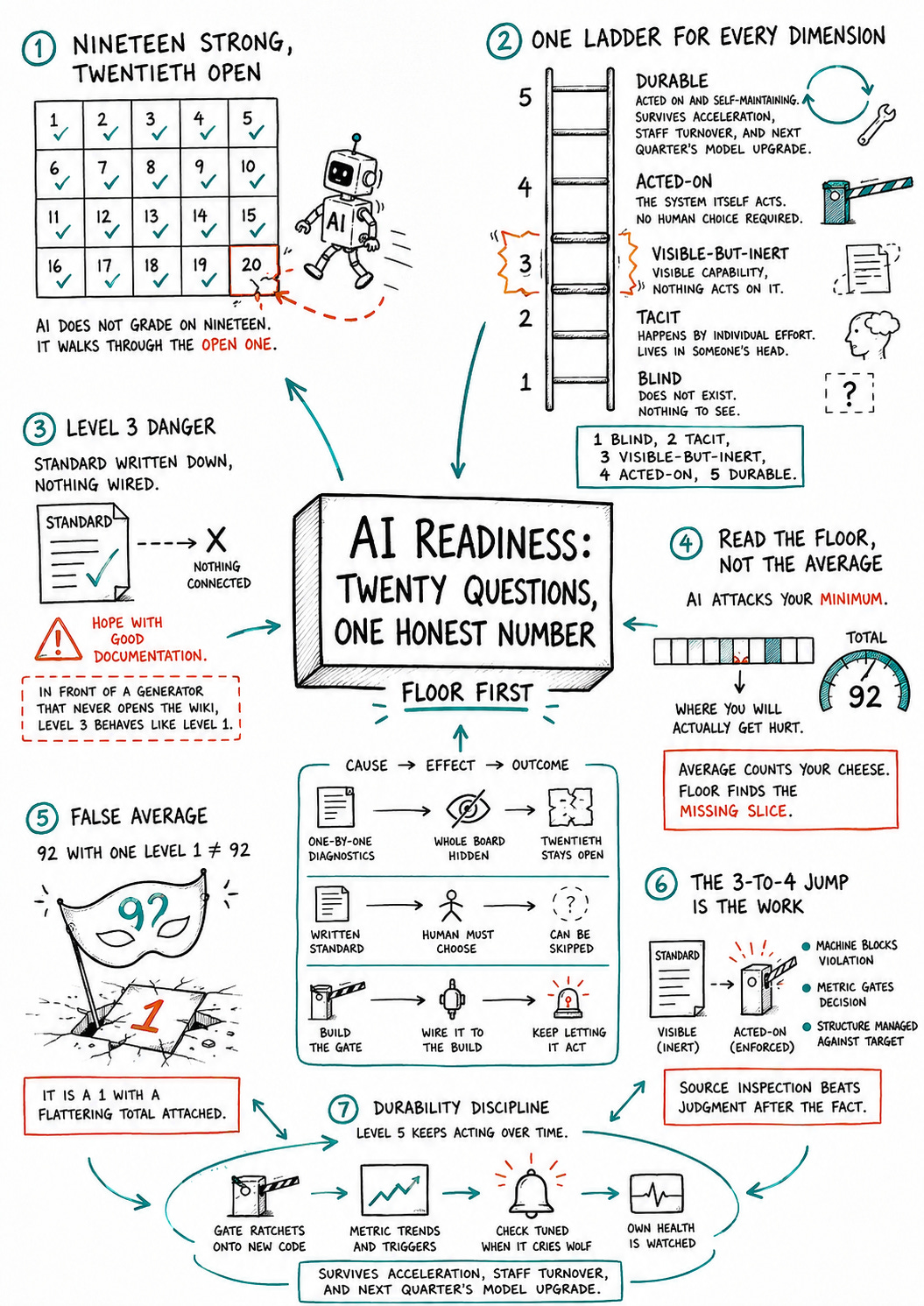
That is how a system gets you. A diagnostic you answer one question at a time never shows you the shape of the whole board. You can be strong on nineteen dimensions and lose to the twentieth, the one a generator walks straight through, because it does not grade you on nineteen.
So this piece puts the whole board down at once, gives you one way to score every square, and teaches the skill the series has withheld until now: how to read your own number without lying to yourself. No new argument, no new dimension. The deliverable is the instrument, and the judgment to read it.
One Ladder, Defined Once
Every dimension gets scored on the same five-rung ladder. The ladder is defined here, once, abstractly enough that it fits an enforcement rule, a metric, and an org structure without bending. One distinction climbs it: does the system itself act on this, or does a human have to choose to?
Level 1, Absent. The capability does not exist. No standard, no metric, no named structure. You are blind on this dimension. There is nothing to see.
Level 2, Ad hoc. It happens, but inconsistently, by individual effort. It lives in someone’s head. Tacit, person-dependent, unrepeatable. The good engineer does it; the system does not.
Level 3, Visible but inert. The capability exists and is visible. A standard is written down, or a metric is computable and has been looked at, or a structure is named and diagrammed. But nothing in the system acts on it automatically. Acting on it is a choice a human can skip.
Level 4, Acted on. The system itself acts, with no human choice required. A machine blocks the violation, or the metric is tracked on a cadence and gates a decision, or the structure is managed against a target and its drift triggers action. It cannot quietly slip.
Level 5, Durable. Acted on and self-maintaining. The gate ratchets onto new code, the metric trends and triggers, the check gets tuned when it cries wolf, and its own health is watched. It survives acceleration, staff turnover, and next quarter’s model upgrade.
One line to hold the whole ladder: 1 blind, 2 tacit, 3 visible-but-inert, 4 acted-on, 5 durable. The staged shape is not arbitrary. It is the lineage of Watts Humphrey’s Capability Maturity Model from 1989, the same climb from heroics to repeatable to institutionalized, pointed at one question instead of a whole organization.
The danger is not the bottom of the ladder. It is the middle. Level 3 is the most dangerous score on the board, because it is the one that feels safe. “We have a standard. It’s written down. Everyone agreed.” True at level 3, and also true that in front of a generator that never opens the wiki, level 3 behaves exactly like level 1. A rule a human has to choose to apply, against an author that makes no such choice, is not a rule. It is a hope with good documentation.
And it is where almost everyone lives. The modal AI-readiness profile is not a sea of level 1s; it is a wall of 3s, the one I see most often walking into an organization: everything written down, almost none of it wired to anything. An earlier piece asked you to sort every standard into enforced versus merely agreed, and everything in that right column sits at level 3 or below. So the whole series, read back to front, is one argument: the 3-to-4 jump is the work.
That jump rests on a result this series has leaned on before, Shigeo Shingo’s mistake-proofing: source inspection beats judgment after the fact. Level 4 is source inspection; level 3 is judgment you are hoping someone exercises. The conversion steps for making the jump already have their own piece, so this one does not re-teach them. It only tells you the jump is the entire job.
Read the Floor, Not the Average
Now the part that makes a scorecard out of 100 lie to you.
A score of 92 with one dimension at level 1 is not a 92. It is a 1 with a flattering total attached. AI does not attack your average. It attacks your minimum. The generator does not spread its mistakes across twenty dimensions in proportion to your score. It finds the one you left open and works there, the way water finds the single unsealed crack.
So the honest reading is two numbers, floor first. Your floor is your single lowest dimension, where you will actually get hurt, and when. Your sum is how broad your readiness is, useful but secondary. A leader who reports the total and buries the floor is doing what the 92 does.
James Reason’s Swiss Cheese model, which an earlier piece used, is the cleanest way to see why. Incidents happen when the holes in successive layers line up. A dimension at level 1 is not a hole that has to align with anything. It is a layer with no cheese at all, always open. Your average counts your cheese. Your floor finds the missing slice. It behaves like the constraint an earlier piece had you hunt for: under AI-paced authorship it saturates first, and raising any of the other nineteen changes nothing until you raise it.
The Readiness Question
End where the series always ends, on something you can answer about your own system.
If you’re close to the code: what is your floor? Name your single lowest dimension, the one square sitting at level 1 or 2 while the others look respectable. That, not your total, is where AI breaks you first. An earlier piece gave you the rung for raising it; this one only tells you which to raise.
If you lead the org: of your five lowest dimensions, how many sit at level 3, visible, agreed, and unacted-on? That count is your real exposure.
One last caution about the score. Reaching level 4 is an engineering act: build the gate, wire it to the build, watch it go red. Holding level 5 is not. A level-5 gate looks identical to a level-4 one in the config. The difference shows only over time, in whether it is still green a year later, after the flake that tempted everyone to switch it off and the deadline that made bypassing it feel reasonable. The scorecard measures whether the system acts; whether you keep letting it act when acting is inconvenient is a question about discipline, not architecture.
That question is the one the final piece takes up, and DORA’s framing is the one to carry into it: the automated gate is not a tax on velocity, it is the brake that lets the engine go faster, and a brake is only worth anything if you keep your foot near it.
So put the whole board down, score the twenty, and find the lowest number on it. That number, not the sum, is your honest answer to whether you are ready.
The Scorecard
Download the Excel scorecard →
Excel workbook with all twenty dimensions, the 1–5 ladder, and floor/sum calculations. Score there; use this article for how to read the result.
Twenty dimensions, five clusters of four. The order runs comprehension, then truth, then flow, then memory, then enforcement, the same dependency order as the series: you cannot enforce what you cannot see, and you cannot trust a gate sitting on top of a pipeline that lies.
Score each dimension 1 to 5 on the ladder above. Your floor is your lowest dimension; your sum is secondary. Below each “Score 4 when” bar you are at 3 or less. Ratcheted and monitored, you are at 5.
Foundation and Structure (can AI comprehend your system at all?)
Question: Is your setup helping AI reason about your system, or forcing it to guess?
Score 4 when: Whichever model you run, its structure is enforced by machine, not convention: scoped builds and enforced module boundaries in a monorepo, versioned and enforced contracts across a multi-repo, so AI cannot drift across a boundary unnoticed.
Your level (1–5): ___
Question: How many of your modules can be understood without reading five others?
Score 4 when: Coupling and complexity carry a tracked budget that fails or flags the build, not just a code-review habit.
Your level (1–5): ___
Question: If you asked three teams what a “customer” is, would you get the same answer?
Score 4 when: The glossary is enforced in naming, lint, and review gates, not parked on a wiki page.
Your level (1–5): ___
Question: Does the same concept have one name in your codebase, or several, and is it worse than a year ago?
Score 4 when: Naming and duplication drift is measured over time and refactoring time is budgeted against it.
Your level (1–5): ___
Truth Signals (does your system tell you the truth about itself?)
Question: If your pipeline went red right now, would your team investigate, or just rerun it?
Score 4 when: Red deterministically means broken (flake rate tracked and driven down), so the signal is trusted.
Your level (1–5): ___
Question: Would your test suite notice if the behavior changed, or only if the code stopped running?
Score 4 when: Mutation or property testing gates the suite, so a behavioral change actually fails something.
Your level (1–5): ___
Question: What percentage of your merged changes get reverted within a week, and is it rising?
Score 4 when: Revert and churn rate is tracked on a cadence and the number gates a decision.
Your level (1–5): ___
Question: Does your AI business case carry an explicit line item for debt remediation?
Score 4 when: Debt is quantified financially and the number gates the AI business case, not buried in story points.
Your level (1–5): ___
Flow and Throughput (can the work move without queueing?)
Question: How old is your oldest active branch?
Score 4 when: Branch lifetime is bounded in hours by policy and tooling (flags, fast tests), not by good intentions.
Your level (1–5): ___
Question: If merge-request volume doubled tomorrow, which stage fills up first?
Score 4 when: The constraint is identified and a WIP limit is enforced by tooling that blocks new work past the cap, not discovered in an outage.
Your level (1–5): ___
Question: If AI doubles each team’s throughput, do the queues shrink or grow?
Score 4 when: Cross-team handoff and queue metrics are tracked on a cadence, and breaching the target automatically triggers a topology review, rather than waiting for someone to notice.
Your level (1–5): ___
Code ownership and review routing
Question: If your busiest team vanished tomorrow, how many open PRs would have no qualified reviewer left in the org?
Score 4 when: CODEOWNERS routes to breadth and review-queue depth is monitored, not concentrated in one silo by habit.
Your level (1–5): ___
Memory and Intent (does the system remember why, and know what it was asked?)
Question: Pick an architectural decision from the last two years: can you find its rationale in the repo?
Score 4 when: Decisions are captured as version-controlled ADRs a reviewer can point to, not whiteboard photos.
Your level (1–5): ___
Question: Could an agent pick up the top item in your backlog and build the right thing without guessing?
Score 4 when: Backlog items are written as testable specs (goal, preconditions, acceptance, edge cases) by standard, checked before pickup.
Your level (1–5): ___
Question: Pick a security assumption your team holds: where in the codebase would an AI learn it?
Score 4 when: Critical assumptions are machine-enforced (one canonical pattern, scans that fail the build), not held in heads.
Your level (1–5): ___
Question: If a new developer or an agent follows your README from scratch, do they get a running system, and would you bet on it?
Score 4 when: Load-bearing setup and run docs are executed in CI from a clean checkout, so drift turns the build red.
Your level (1–5): ___
Enforcement and Release (is the rule a wall or a wish, and can the outside world tell what changed?)
Hard guardrails vs cultural agreements
Question: Have you sorted your standards into enforced versus agreed-upon, and do you know how short your agreed-upon column is?
Score 4 when: That sort is a maintained practice that routes the costly agreed-upon standards toward enforcement, not a one-off workshop.
Your level (1–5): ___
Architecture enforcement in CI
Question: Does your CI fail the build on an architectural violation, or do you rely on a reviewer catching it?
Score 4 when: A scoped fitness function (ArchUnit, dependency-cruiser, import-linter) fails the build on a boundary breach.
Your level (1–5): ___
Question: Of the dependencies you run in production, how many did a human actually choose?
Score 4 when: Imports are grounded in the live registry and gated by an existence and cooldown check, with a human on the import line.
Your level (1–5): ___
Question: Can your consumers tell what changed in your last release, and whether it affects them, before they hit it in production?
Score 4 when: Change visibility is engineered into the runtime (deprecation headers, signature-change alerts) at code-generation tempo.
Your level (1–5): __
_