

Executive Summary
SoftNet, a 30-year Kraków software house whose systems run 100+ banks, had months of real AI experiments and a strong improvement culture, yet adoption stayed local at individuals or single teams. Cycle 1 of H³ (Harvest, Hack, Harness) ran across three days in June 2026 with 15 to 20 of its 50 to 60 developers. Four outcomes left the room with named owners: a skill-evaluation system shipped to main, the first AI Guidelines repository that legal and compliance were glad to see started, automated E2E tests based on expert interviews for EuroBankNet now running in CI/CD, and a self-hosted local LLM exploration that concluded self-hosting was not worth it and redirected toward managed AI in JIRA Rovo or GitLab Duo. Nothing was killed. Three days do not finish adoption. They start it. The measurement happens across the summer Gap and is reported at Cycle 2 in September.
The morning after we closed the cycle, Adam committed code to main.
Not a memo about the cycle. Not a slide deck summarizing it. Actual code. One of the topics from the three days was a shared place for the team’s AI skills, and Adam needed a way to copy things over into OpenCode. So he wrote it and pushed it himself. Adam is the Sponsor. He holds the formal mandates, the budget, the air cover. And the day after the room emptied, he was in the repo like everyone else.
If you have ever watched an executive open an AI initiative with a keynote and then vanish, that small commit is the whole story. Hold onto it. I will come back to it.

SoftNet did not have an AI problem
This is the part most enterprise AI stories get wrong, so let me be precise about it.
SoftNet is a software house in Kraków. For more than 30 years it has built banking systems, and today its software runs in over 100 banks across Poland, most of them cooperative banks. Its central banking system, EuroBankNet, sits at the core of how those banks actually operate. Security is not a marketing word here. It is the product.
By the time we ran this cycle, SoftNet had been experimenting with AI in development for months. Not vaguely. We had run TDD and mob programming together, moved into AI usage inside a kata environment, then into monthly AI-augmented development experiments. Some of those experiments were genuinely good. I have written about two of them.
In “AI-First Development Isn’t About AI”, six teams produced 83 stories and 315 Specs By Example in a two-day workshop on a clone of SoftNet’s real stack, and the lesson was that speed shows up after the guardrails exist, not before. In “From PRD to Production in Two Days”, a real financial feature shipped to production in two days, and the honest failure was that review discipline decayed the moment the team got comfortable with AI output.
So the experiments were real, and a strong self-improvement culture was already there. And yet adoption stayed local. Things kept moving. They just never spread.
The wins lived with the individuals and single teams who ran them. There was no mechanism to carry a proven idea across the rest of the org. And there were no written AI guidelines. Legal and compliance had given verbal recommendations that people honored, but nobody had written them down. The rules everyone half-followed existed only in people’s heads.
That is the real shape of enterprise AI. The hard part is not the models. SoftNet had the models working. The hard part is getting a whole engineering organization to adopt what a few people proved, and to write down the rules everyone is already pretending to know. That is an organizational problem, not a tooling one. It is the one this cycle set out to move.
Three days that buy you a Gap, not a finish line
A word on those three days, because the phrase invites a fair objection. Nobody adopts AI across a 50-person org in three days, and I am not claiming they did.
The format was deliberate. A half-day Harvest, a full-day Hack, a half-day Harness, then a three-month Gap. I chose that shape over a longer, denser workshop, and the trade-off is real. More time in the room would have produced more output. It would also have produced less adoption, because the people would have left with my momentum instead of theirs. The room is where ownership gets assigned. The Gap is where adoption is actually earned. If you want the method itself, it is laid out at harvesthackharness.ai.
What three days produce is owned, named, tracked motion. Promoters who carry a topic. Cards in a tracker. A committed system. A guidelines repo. Adoption comes later, across the summer, and gets reported in September. The narrower claim is the stronger one.
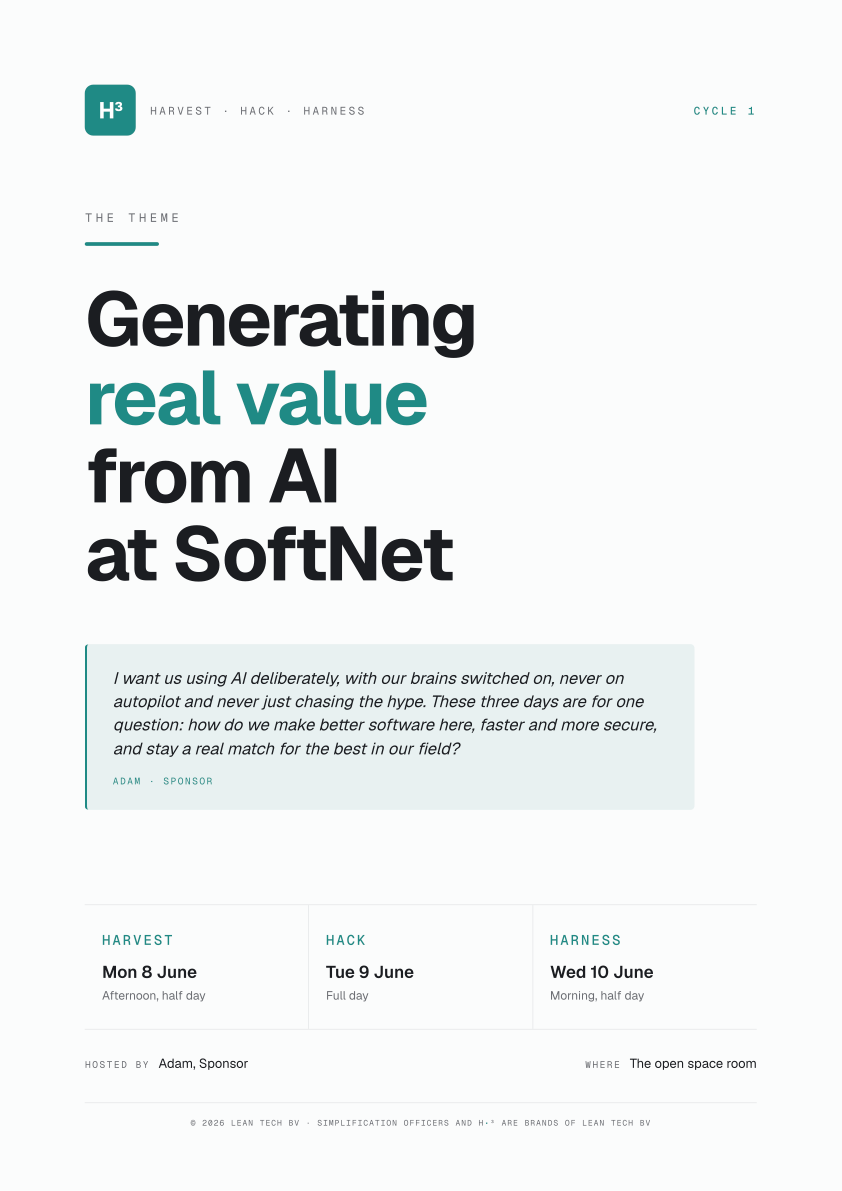
Adam set the theme himself, and he did not hand it to a facilitator to soften:
“I want us using AI deliberately, with our brains switched on, never on autopilot and never just chasing the hype. These three days are for one question: how do we make better software here, faster and more secure, and stay a real match for the best in our field?”
For a company whose code runs other people’s banks, that is the only posture that holds.
What happened in the room
Jakub Perlak co-facilitated all three days with me. An open agenda needs that: one facilitator can hold the front while the other moves with the groups.
Harvest felt awkward for a moment, and I let it. An open agenda is unfamiliar. People are not used to a room where you simply step up and share what you are working on, unprompted, with no slot booked for you.
Then Adam stepped up first and shared his own AI experiments. Others followed. Team notfound demoed a software-modernization analysis system: generating good repository data as input, pulling knowledge from markdown and architectures, with a clear way of working to gather data for analysis. It turned a vague modernization headache into a very strong foundation to build on, and the room did exactly that.
Central sharing surfaced around 15 to 20 raw topics on the wall. That is exactly where Harvest is built to turn: out of sharing at the front and into open-space discussion groups, where people pick the topics they care about and dig in. The temptation, for a facilitator, is to stay at the front and keep performing. The design says do the opposite.
So we made the move. Smaller groups, self-chosen, slower and messier to watch from the outside. But the insight that came out of them was theirs, not mine, and that is the only kind that survives the Gap. The structure was the engine, not me.
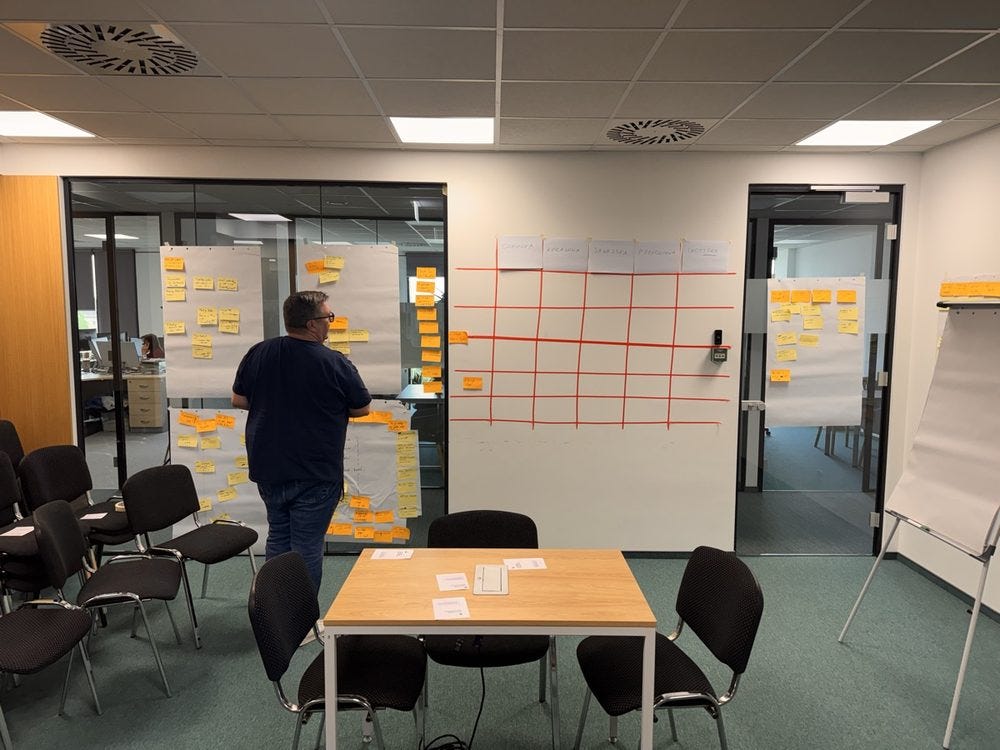
The smaller groups generated far more than the plenary had. Questions, challenges, sharper ideas. The Themes Wall resolved into seven clusters:
Sharing skills across teams.
Self-hosted local models.
Automating the work that matters but nobody enjoys.
Measuring AI usage.
Experiences with Context7 and other skills.
The software-modernization analysis team notfound had started.
Using AI to plan based on tech and function.
Raw topics on one color of sticky, the harder questions on another.
Hack ran the opposite way. People had largely decided what to work on before they walked in, so the day moved. Three main topics went forward. The E2E group split into sub-groups and spent the day consolidating their results across the room.
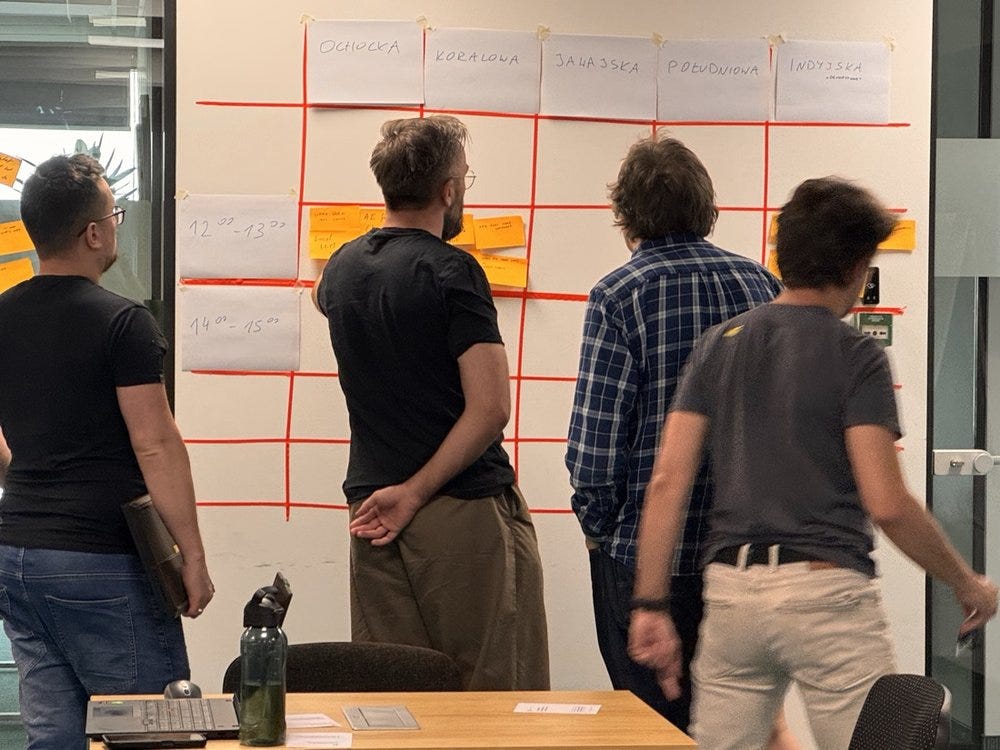
I paired in personally on the skills-sharing and quality topic. That was a choice with a cost. I had already experimented with it in private pet projects and gotten real results, and the quality guardrail is load-bearing for everything else, so I wanted that system to actually ship rather than be sketched on a flipchart. The cost was that I spent less time floating across the other groups. I would make the same call again. A skipped guardrail is the most expensive thing in this whole story.
At the lunch status update, the progress gave me goosebumps. I will leave it at that.
Harness was the formal close, where each topic gets a Promoter and a destination. Some people I had not expected demoed their work, and demoed it in English rather than their native Polish, for the benefit of the room. Live demos, not slides. Adam confirmed his interest in the topics and offered budget or anything else a Promoter’s mandate could not reach. Air cover, stated out loud.
Four cards, named honestly
At Harness, every topic lands on a destination: Adopt now, Exploring, Shipped, or Killed. Four cards left the room. Here is where each landed, and why the destinations matter more than the count.
The skill-evaluation system. Shipped. A central place for SoftNet’s AI skills, with evaluation enforced by a git pre-push hook, evals for skills in the repos, and a discipline of writing the test scenario before the skill. Promoter: Mateusz, with Adam and me on the team. It was committed and pushed the same day. Not a plan to build a system. A system.
The first AI Guidelines. Adopt now. Kuba kicked off an ai-guidelines repository inside SoftNet, with folders for decisions, standards, OKRs, a knowledge base, suppliers. The first guidelines went in: how to use the marketplace and plugins in Claude Code, how to use the skill-evaluator agents, how to add new skills to the marketplace. The rules that lived in people’s heads are starting to live in a repo. And Piotr, from legal and compliance, was happy to see it. Not a formal sign-off, the guidelines will need to grow a lot before that, but genuine relief that the rules were finally being written down at all.
That reaction is the one I would underline. An earlier piece in this series warned about the comfort trap, where review discipline quietly decays because AI output looks good enough to trust. The pre-push evaluation hook and a guidelines repo that compliance wanted to see are the beginning of an answer to that warning. One holds the line mechanically. The other starts writing the line down where everyone can see it. In a company that builds bank software, having compliance glad the rules are finally being formalized is not a footnote. It is the difference between a rule that sticks and one that stays in someone’s head.
Interview and E2E tests based on expert interviews for EuroBankNet. Adopt now, and still Exploring. A card can carry both destinations at once: part is already in use, part is still being worked out. Promoter: Magdalena. The team built AI skills for discovering and generating end-to-end tests for EuroBankNet, and some of those tests are already running from the CLI and in CI/CD. Next, they refine the skills and promote the approach to others through a workshop or an article.
Read that one slowly if you are a bank. EuroBankNet’s core runs on a decades-old foundation, Clipper/Harbour. Legacy is normal in core banking, and stable, decades-old code is not a flaw. What is new is the rigor now being applied to it. A core that runs 100+ banks is getting automated regression coverage. The supplier built it, deliberately and security-first. If your reflex is to ask whether they are letting AI loose on the system that runs your bank, the answer is in the posture: deliberate, guardrail-first, compliance-aware, owned. Adam’s theme was not decoration. It was the operating instruction.
Self-hosted local LLM. Exploring, then redirected. Promoter: Kamil. The team went after a support-desk case and found that self-hosting a model was too complex to be worth it. So the exploration changed direction: rather than run a model in-house, adopt the AI already available in the tools they have, JIRA Rovo or GitLab Duo. Next steps: improve data quality for Rovo, give the support team JIRA access, train them on it.
I want this card to stay visible, because it is the one that makes the other three believable. The original idea, self-hosting, did not survive contact with the work. It did not ship, and it did not get a triumphant write-up. It got an honest “this is harder than it is worth, here is what we learned, here is the better path.” Redirecting toward Rovo or GitLab Duo is not a failure. It is what exploration is for. A cycle that produces only wins is a curated highlight reel, and experienced buyers can smell one.
And nothing was Killed this cycle. The destination exists. It was simply not needed this time, which is itself a data point rather than a thing to hide.
Why it actually moved
Here is the temptation I want to resist on SoftNet’s behalf: to claim this worked because of the framework, or to claim it worked despite the framework because SoftNet’s people are just that good. Both are wrong, and the second is the more flattering lie.
H³ supplied the structure. A rhythm. Named ownership through Promoters. A Gap with a deadline. SoftNet supplied the fuel, the engagement that made the structure bite. Neither was sufficient alone. An unstructured year of experiments had already proven that the fuel without the structure does not compound. The wins stayed local. The structure is what let the culture finally spread.
And the structure only worked because the culture was real, which you can see rather than take on faith. Titles do not matter here, so the Sponsor sat in a working group, not above it. People nobody had flagged stood up and demoed, in a second language, for the room. And the morning after, the Sponsor committed code to main.
When people are engaged in their motivation, you get results like that. I did not have to manufacture any of it. I had to give it somewhere to go.
This is the move that matters for anyone watching their own AI experiments win locally and go nowhere: experiments without an adoption mechanism stay experiments. The Promoter, the Gap, and the Themes Wall are that missing mechanism. Not better prompts. Not a bigger model. A structure that carries a proven idea past the person who proved it.
The Gap is where this gets tested
So far, 15 to 20 people moved. The org has 50 to 60 developers, and eventually other departments who sat this cycle out. Moving from the engaged few to the whole group is the actual job, and it is unproven. I will not pretend otherwise.
That is what the Gap is for. The three summer months are when the guidelines spread or do not, when the E2E approach gets promoted or stays with Magdalena’s group, when the Rovo and GitLab Duo route either earns its keep on the support desk or gets honestly parked. Within two days of Harness, the early motion was already there: guidelines initiated and spreading, Kamil deeper into Rovo, the E2E group consolidating further, Adam’s commit. Early motion is not adoption. It is a signal that the mechanism is turning.
What gets tracked across the Gap is simple to name. Did the skill-evaluation system get used by people who were not in the room. Did the guidelines get followed and extended. Did E2E coverage on EuroBankNet grow. Did the Rovo or GitLab Duo route prove out on the support desk. We report it all at the mid-September harvest, which opens Cycle 2.
Jakub Perlak, who co-facilitated every session this cycle, is carrying the facilitation forward across the Gap. He is on his way to becoming a trusted H³ coach.
And Cycle 2 only earns its place if the Gap shows visible motion. That is the skin in the game. No motion, no next cycle. The honesty of that bar is the point.
The last thing Adam did
The strongest evidence I have for any of this is not in the tracker. It is that commit to main, the morning after.
A Sponsor who ships code is telling the whole organization something no keynote can: this is ours now, not the consultant’s. SoftNet said the same thing publicly, in their own account of the three days, posted in their voice rather than mine. The three days did not finish SoftNet’s AI adoption. They handed it back to the people who will live with it, with a structure to carry it and a date to be measured against.
Now we find out what they do across the summer. That has always been the real test, and it is the only one worth grading.
H³ (Harvest · Hack · Harness) is the cycle described here. The method is at harvesthackharness.ai.